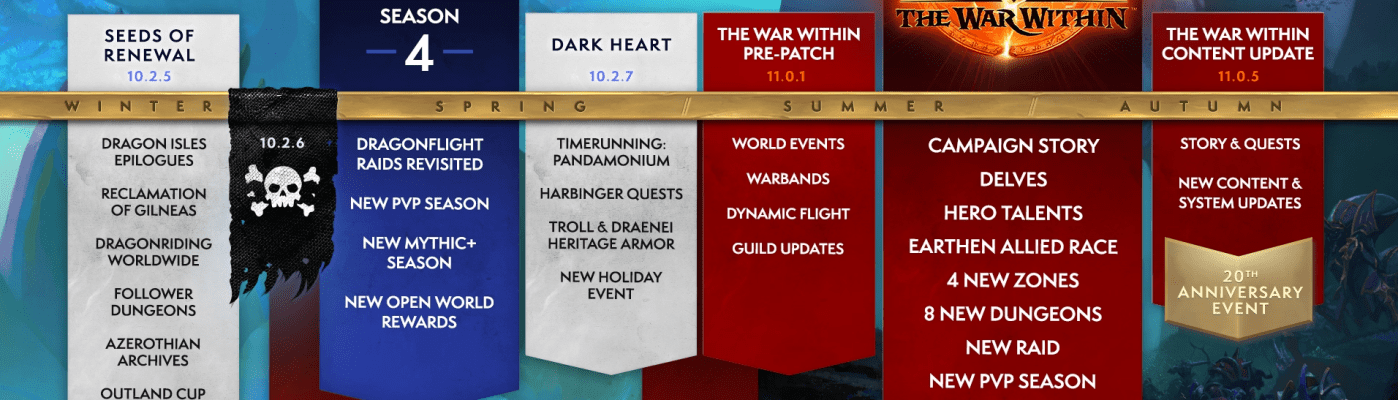
Today, Blizzard dropped a doozy of a post detailed the roadmap for 2024 in World of Warcraft. There were both modern and Classic WoW versions, each with their own peculiarities, and today I want to focus on the modern WoW one.
Dragonflight has been, to my eyes, a good expansion. It also hasn’t changed as much as people might have liked, so while it represents an overall improvement over Shadowlands (not a high bar, but I digress), the game has very clearly not returned to the pre-Shadowlands level of hype or excitement. Dragonflight broke the new-highest-selling-title streak for WoW expansions, but that is less an indictment of Dragonflight and more an expression of general unease and sentiment towards the game as an entity. For many people, it takes a couple of proven products to convince someone who walked away from a thing to bring them back into the fold, and for those who sit on the sidelines for gameplay reasons…well, the game may have done a fair bit in Dragonflight to make the next expansion, The War Within, a more appealing proposition. For others, the story needed some substantial improvements, and while Dragonflight is better than Shadowlands in my opinion on the story front, it still kind of sucks. In a better and different way, at least, so I guess that’s nice – but for those waiting for evidentiary support of focused story improvements, they’re likely waiting longer (subjectively, of course, nothing wrong with liking a story even if the structure and narrative construction of it is iffy).
This roadmap, much like the initial Dragonflight roadmap we saw around this same time last year, is an attempt to put forward a comprehensive message about how on-track WoW is. It confirms some hunches I’ve had (release dates, overall cadence of content) while disproving others (my beloved Season 5 theory is shot dead!), and it serves as a useful template for us to discuss where the game is going while also containing some buzzwords and generic hype that is going to be difficult to get too excited over until we know more.
Dragonflight’s End
Dragonflight is confirmed to have 3 remaining minor patches, 1 on PTR now, 1 that has some details listed on the roadmap, and a third that is being teased rather weirdly.
Firstly, 10.2.5, the current PTR patch, is due for release in January, and contains the finale quests that wrap up Dragonflight’s story alongside a mix of other features. Dragonriding basically becomes dynamic flight in this patch as the mode of flight becomes available worldwide in WoW’s expansive landmass, albeit at reduced speeds in all the areas it wasn’t designed for. There’s also the implementation of Follower Dungeons for Dragonflight normal dungeons, which introduces FFXIV’s Trust/Duty Support system in a limited fashion to allow players to run dungeons with partial or fully NPC parties. With Dragonflight becoming the intended new player experience in 11.0, this makes sense and it likely signals that something similar will hopefully be available for TWW dungeons, to keep players who want that solo experience able to play through more content. Overall, not a huge patch but there is a decent mix of content with multiple story leads that interrelate – the relocation of the Night Elves (boy, I have opinions about that one, but I’ll save them for a story writeup), the related fallout for the Worgen as they attempt to reclaim Gilneas, and a mix of gameplay content and updates like balancing, an Outland Dragonriding cup, and a Hearthstone anniversary event.
In the spring, we get 10.2.6, which has a skull and crossbones as the only indicator of content to come, and it seems likely that this patch will also be the Season 4 rollout patch. We don’t know enough about either to say much, other than that the promise is a full new season with “Dragonflight Raids Revisited” but no details on how that will relate to Mythic Plus dungeon pool or what the Season 4 raid changes will entail. This also starts around the same time as the TWW alpha test begins.
Then there’s 10.2.7. This seems to (and this might be optimistic on my part) contain some events to set up the War Within expansion, with “Harbinger quests” and something called “Timerunning: Panadmonium” which has led to some people speculating we might see the return of Mists of Pandaria’s challenge modes (and as someone who only got the Priest armor set from them for the Golds back in MoP, I kinda hope so!). There’s also new heritage armor sets coming for the Trolls and Draenei and a new holiday event (depending on how late into spring it runs, who knows?).
Overall, as a course set for the end of Dragonflight, it’s a good enough plan in my opinion. From the perspective of WoW’s best-served audience in the dungeon and raid-running community, it signals a clear commitment to more content and while the throwback season for raids can be iffy, it also presents some good opportunities to refresh things as well as to create new chase opportunities for gear and rewards. For one thing, it should make the dragonriding skins from the prior two season’s raids easier to farm (since they’ll be current content finding a group should be easier), and it should be an interesting look at how Blizzard balances rewards given the model differences between DF and Shadowlands – Shadowlands had only just returned tier sets to the game in season 3 while DF has had them the whole time, while SL had only a drop-legendary to worry about from a raid perspective while DF has has two crafted legendaries that requires rare drops and a shitton of material cost to make. I have some fun theories about those topics I plan to share in a future post!
For the world content enjoyers that are the actual majority of WoW’s audience, there’s decent reason to be excited. Dragonflight’s major improvement to the modern WoW model has been a far more responsive and frequent set of updates to stuff that players can do in the world, with Blizzard using minor patches to release more new world content between content seasons to keep the biggest part of the playerbase onboard. For whatever criticisms I do have of the Dragonflight model, I think it is still good that people who primarily engage with world content are more constantly given new things because I think that they are often forgotten in the game’s past, with the stuff that is made for them being held to accompany a major raid/dungeon release. The minor patches we have content information on tell us that open world content and rewards are a focus and will remain in the spotlight, especially good given that Season 4 of Shadowlands didn’t really provide an update in that same way.
But then we get to an even more interesting morsel…
The War Within – and Without
Dragonflight has seen the WoW team release content faster than before, and it overall has kept the game feeling fresh with some caveats (I think that the gap at the end of Season 2 was a bit long but that is also a personal preference given that I bounced off that season before finishing my goals). When Blizzcon 2023 told us that The War Within was launching in 2024, I think we all sort of expected the early or late Fall windows, which is normally Blizzard’s strike zone for new expansion launches. The roadmap we received today, however, tells us differently – that TWW’s pre-patch will be late Spring/early Summer with the expansion launching in the summer season as well.
Firstly, as a fan of both WoW and FFXIV, I cannot help but notice that this seems like an attempt to get back to aggressively counter-programming FFXIV content launches, as this is something they’ve largely avoided since they tried it with the Mage Tower Timewalking feature in 9.1.5 as a counter-push against Endwalker, which kind of blew up in their face while they were bleeding subscribers at the time. Dawntrail’s launch date is still TBD, but the summer window is announced already and given that Square Enix is trying to put FFXIV back on content-cadence, I’d suspect that expansion will launch in late June with the first weekend of July being the latest time I would expect it. This will, however, be the first time that both MMO juggernauts have had near-enough expansion launches. In the past, it was always a dance that was a losing prospect for whomever wasn’t launching the new expansion – Shadowbringers launch was counterprogrammed with 8.2 (oh boy, Nazjatar, fuck me I hate that place) and on the other foot, you’d usually have wind-down patches for FFXIV like a lot of the x.4 patches launching in the window that new WoW expansions were on-deck. It’s either a bold and confident move or extremely stupid, and much of my opinion of that depends on how good both expansions are! Until we have specific dates, I can’t really confidently say this is an explicit counter-program – but in a couple of weeks I suspect we’ll have a Dawntrail release date and if the TWW date follows close-enough behind (and is close-enough to DT or day-and-date), well, we can revisit that conversation then.
Secondly, this will make Dragonflight the shortest-lived WoW expansion, at roughly 18-20 months. This is, to me, a good thing actually. A lot of my favorite expansions in WoW have marks against them because they lingered too long on the last season of content – Wrath having a year-long ICC cycle, Cataclysm having the same for Dragon Soul, 14 months of Siege of Orgrimmar, and more – WoW has historically tread upon goodwill in the final patch cycle because they just take too damn long, and that is a shame. I’d rather have the chance to think that I liked the expansion and am still enjoying it as it fades to black and the new one comes into focus, instead of being on a hiatus because there’s just not that much I still want to do in WoW outside of current content during those long droughts in the release schedule. If this becomes the new normal for WoW, with expansions at 18-20 months instead of 24-26, that is, unambiguously I think, healthy for the game. New stuff happening more frequently, shorter overall seasons by a slight measure so that there is new stuff happening regularly – that is all pretty damn good to me. Dragonflight’s model moving into the future of the game, with more-frequent content updates, less waiting for raid patches to introduce stuff for everyone else, and a more-responsive Blizzard doing things like class and spec reworks mid-expansion – all of this is great, genuinely, and I think that if this model continues, the game is going to be in an overall good place.
While a shorter lifecycle for an expansion could sometimes mean a shortage of content, Dragonflight hasn’t felt like a bad deal – 4 seasons, more world content than most expansions, a lot of sidequests and story content (varying quality levels aside), and a solid rewards track and progression that feels consistently rewarding while shoring up some weaknesses that WoW has traditionally faced. All in all, that’s a decent expansion, and as a template for what we might expect going forward, it’s pretty neat. In many ways, it’s interesting to see the split in the two major MMOs – FFXIV explicitly elongating their content cycle to allow more time for staff to work with vacations and time off (even after Endwalker, the new norm seems to be 2 extra weeks per patch cycle) while WoW explicitly aims to shorten their cycle and rapid-fire new content in 6-8 week segments for an 18 month overall expansion length.
And the roadmap concludes confirming that by the end of calendar year 2024, The War Within will receive its first minor patch, with the fall marking the drop of 11.0.5 with story quests, “new content” and the container for the 20th anniversary event.
Roadmap for Clear Travels
So for the second year now, Blizzard has given us a roadmap document that has become the norm for live service games, detailing all the ways in which they expect to keep us engaged with WoW in 2024. Like last year’s version, I genuinely think this is a great move that puts a lot of goodwill into the pool for Blizzard. Any small critiques I could have about potential counter-programming and such are minor and silenced by the fact that as a person who enjoys playing WoW, this feels like a good plan and a good show of effort on their part that continues to build on the overall positive momentum of Dragonflight.
Sure, Dragonflight in some ways has not been the smash-hit success that Blizzard probably wanted. It hasn’t outsold prior expansions and there’s definitely still a lot of now-former WoW fans on the sidelines waiting for the signal to make a return, and not everyone is seeing it yet. From a gameplay perspective, if you like modern WoW, Dragonflight has been excellent on that front and it seems like The War Within is going to build upon that strength. From a story perspective, well, the game hasn’t made enough meaningful moves on that front yet to win over a lot of people, but I think that how TWW performs on the narrative front will be the real interesting test – will Metzen’s return to a lead creative role on the team usher the game into a new golden age alongside well-tuned and better-serving content and gameplay systems? We don’t know yet and can’t know. Metzen is an interesting writer with his own set of quirks, but I generally liked his output in that role and I am curious to see how he works to create a path from the current lore, an amalgamation of his old writing with new beats and plots written by his various successors, into a new future. A lot of what’s promised for gameplay is already very up my alley and so I’m eagerly waiting in that regard, at least.
Blizzard has needed to right the ship for WoW for a minute, after a few lackluster expansions of weird single-use systems and a lack of content. Dragonflight started that effort in earnest, and it has done fairly well, but it could never be the pull-back point for a lot of people because Blizzard has needed to establish a track record of successful changes to get that faith back for a lot of players. I think that this roadmap and The War Within could, potentailly, be an inflection point that does the work needed to start pulling those people back in. How successful it is at that endeavor is obviously a factor that remains to be seen, but there’s some reason for optimism, which is pretty neat, all told.
 Kaylriene