One of the major changes (arguably a marquee change alongside player housing) coming in World of Warcraft’s Midnight expansion is the largest set of changes to the WoW addon API that has been seen since the game first launched. Blizzard’s core philosophy on addons is changing to a more hardline stance against combat-facing addons, and the change is more sweeping than we previously thought. For Blizzard’s plans, they’ve pushed 3 major changes that will facilitate a future sans combat addons, and so I wanted to write a 3-post series discussing the changes – the addon API and what is currently set to be allowed/disallowed, the combat changes coming to all specs and classes, and the announced design changes for encounter design that are aimed at creating a new era of WoW combat where the lack of addon-solving is less of a problem than it would be if current designs were just kept as-is.
Today, we discuss class and spec design!
Dream of Overcomplication
Currently, WoW specs are a mix of different effects that converge for you to perform at peak. Playing a modern WoW spec is a complicated juggle of managing a base rotation alongside a priority system for changes and tweaks, managing cooldowns and burst windows effectively, ramping gameplay for healers, defensive mitigation management for tanks, defensive self and group protection for all, and managing a myriad of random chance effects, stacking buffs, and gear effects like trinkets and consumables to maximize your performance. A part of the appeal of modern WoW is that this complex patchwork of different factors all weave into gameplay, meaning there is a near-limitless depth to how far you can go to really play optimally. The downside to that, however, is that this level of optimization is incredibly hard for a new player to even grapple with in-game, as the game itself does an atrocious job of teaching nearly anything about rotational gameplay, much less burst windows, cooldown optimization, or defensive gameplay.
Just like with boss mods, a big reason why class and spec WeakAura packages along with rotation helpers like Hekili have become popular is because the game just simply has so much going on in the average spec design that you have to manage. Rather than designing away from that and simplifying, Blizzard has previously moved to enshrine this level of complexity, and while it means that high end players have a ton of room to really dig in and nerd out, the average player is often left behind. That complexity reached an inflection point in Dragonflight, because…
The Talent Revamp Was Kind of a Bad Mess
We can say it now, right? Talents since Dragonflight have been a bust, in my opinion, and there’s a very simple reason why – Blizzard peeled out all the things you used to get from rank-ups to spells while leveling, the effects of Azerite armor and legendaries of the past, and some basic old-school style talents and slapped them all into a tree, and that’s fine to a point, but it also leads to a mess of different effects. If the game explained these on the baseline tooltip for a given spell, that would be great…except it doesn’t, and also, with an addon (irony!) you can do that and some of them get messy. Renewing Mist for Mistweaver Monks has so many distinct modifiers from talents that it takes up an entire HD display vertically to show all the effects in one tooltip, and almost every spec has something similar. If I search Eye Beam in my talent tree as a Havoc Demon Hunter, there are 8 different talents with modifiers for Eye Beams, and 9 total nodes if we count Eye Beams itself! If I were to switch to Fel-Scarred Hero talents, there would be even more!
Old talents, like vanilla old, worked because they were, sorry Classic stans, boring and dull on their own. Oh man, I can buff one spell by 3%, awesome! But the gameplay value was in the choice and the fact that most of them were attainable, so you gained power through this mechanism while being allowed some room to make different choices. The current talents tried to be modern and succeeded, but did so largely by taking much larger bonuses and effects and smushing them down into talent form, so where before such a loadout of powers would require the best legendaries of all eras for your spec plus Azerite armor with perfect traits, now you just get that folded into the kit. It also takes away some of the passive aspects of leveling powers and makes them choices in a baffling way – Eye Beams was my preferred example because in Shadowlands, DHs got rank upgrades to Eye Beams that folded in two of those talents right off the bat and then, at most, could have a talent that interacted with it and one legendary that might also empower it. Now, you get all those effects via talents, which makes base Eye Beams weaker but then the tooltip never updates to fully show the changes and empowerments you get from these talent interactions and so a rookie player could very well never understand the full synergistic effect of their build.
And since we mentioned choice, the other issue with the current trees is that they are railroaded to guide you to certain choices. By building the trees as they have, Blizzard has made it such that you can only take certain combinations of powers, which was sort of true back in the day with the older tree versions, but they have built the new trees in a way where those endcaps are far more appealing – and require you to take a more specific route down the tree to navigate to it. That’s fine enough on its own, but altogether as a system, it leads to a place where choice is limited.
To address the last sort of elephant in the room, talents have always been cookie cutter in a way in WoW. But in the old days when we copied builds, the effects were relatively tame and easy to understand. The current effects, even most of the basic ones, are substantially more involved and require more thought and understanding, which exacerbates the cookie cutter effect and also leads to a lack of understanding when you do start to try and dig in to your talent choices. In the current paradigm, all of these effects lead to either two outcomes – you have interesting choices in your talent tree which means that none of the individual choices are all that great and you’re picking which mediocre enhancement to take, or your talents are amazing individually, which pushes one build over the others or creates a situation where certain talents cannot be left out of a build if you want to perform well.
So you get your good template build, and then what?
The Buff UI Is Stuck in 2004 and That’s Why We Use WeakAuras
WoW’s classic UI design put buffs out of the way at the top of the screen, which is fine enough when we’re just tracking raid and party buffs and there’s not a lot else in terms of moment-to-moment actionable feedback there. In 2025, the buff section of your UI is almost always a clusterfuck by design, because Blizzard uses buffs for fucking EVERYTHING in WoW. Do you have Mark of the Wild? Good to know, buff, icon. Is it pet battle week in the game? Yep, okay, here’s a buff to tell you that too. Do you have a mount out? Buff. Dragonriding spells and conditional modifiers? Buffs. Talent procs you need to track in the moment to determine when you use an ability that consumes them for a huge effect? Best believe that is a buff.
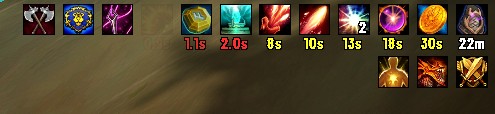
The buff section is a crowded mess where information goes to die, and Blizzard’s built-in options for filtering it are insufficient. In the current state of the game, I really need to be able to sort information auras (weekly events, dragonriding state, RP flavor auras) from static buffs (raid buffs, long-term consumables like food and flasks) from momentary effects where I need a lot of attention on them (talent procs, trinket/tier set effects, potion duration), and ideally I’d like to put them into different places, so the static and informational auras can go out of the way but I want those momentary effects front and center so I can track them closely.
Blizzard’s UI design has been stuck with the vanilla model for buffs basically forever, and it has made up a large part of the challenge in just seeing the information you need to succeed. Blizzard’s haphazard fixes, like glowy screen effects and highlighted buttons, kind of help, but the aura glows are indecipherable gibberish to new players (hell even I oftentimes don’t know what the default glows are trying to say other than that the Evoker penis frames mean I have Essence Burst)(sorry but they look like dicks, everyone pointed it out immediately on DF pre-patch!) and the button glows are meaningless when multiple different buttons can all light up like my hotbar is on fire.
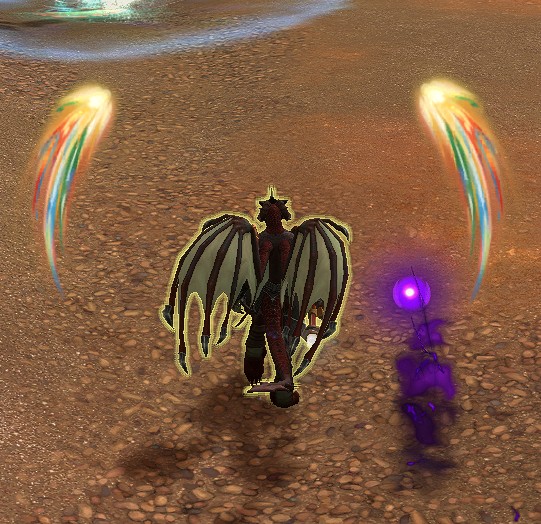
The addon problem that Blizzard has is, again, a creation of their own design, because given the state of buff tracking in the game, of course a savvy player is going to find a way to bundle the useful information where it can be readily seen and acted upon, and a new player trying to use the tools provided by Blizzard is going to struggle – hell, even a veteran player is going to struggle to play at full optimization with the stock UI because it is not a helpful display of information where it can be read. As long as classes remain a jumbled mess of overlapped effects needing management, that’s going to be the case…so now we turn our eyes to the future state and what we can see so far of Midnight.
The Midnight Streamlining
In Midnight, Blizzard’s announced changes so far in Alpha are to prune down active abilities and pull back on the layers of interactions that define current specs in combat. Many maintenance buffs or heavy proc effects are simply going away, most classes are losing a large number of talentable defensive options, and healers are being moved away from ramp models and cooldown shuffling in favor of more baseline healing and less usage of cooldowns with more overall impact. All of these changes aim at reducing complexity, at least in terms of tracking requirement, prerequisite setup for big damage, and overall layers of ability interactions. Those things with 8 different modifier talents are being heavily streamlined by either baking in the multitude of modifier talents, reducing the complexity of those interactions, or simply pruning the modifiers altogether. Reducing defensives is aimed at making healing less ramp-heavy and giving healers more room to actually heal – both by putting group survival more into the healer’s hands as well as by removing the amount of damage abilities have to hit for in order to be an interesting challenge.
For tanks, this simplification is largely to layered defensives, either by removing talents that add survival to make them baseline kit or by removing layers like Brewmaster Monk having Diffuse Magic on top of other defensives that are active button presses – the new form of Diffuse Magic tags along onto Fortifying Brew and adds the effect, so it removes the button while maintaining some aspect of the current form. Most tanks are losing some form of additional defensive as it seems the intention is both to reduce complexity while also allowing healers some additional room to tag in for their tanks. For healers, this is largely about removing or reshaping some major cooldowns and synergistic talents, putting more baseline power into rotational heals instead while removing layers of defensives from everyone such that the healer will always have some work to do (and so that raidwides in high-key M+ no longer have to be 100+% health hits to be a threat). For DPS, this means removing layers of interaction that could be cumbersome or awkward, like simplifying Outlaw Rogue’s Roll The Bones or removing mechanics like Bloodtalons for Feral Druids so that there’s no longer this weird layer of tracking needed to ensure you’re always at top performance.
Lastly, in a comment reminiscent of Legion design, a stated goal of this project is to align power into abilities that look like they should be more impactful, meaning abilities with large flashy visuals are likely going to be gaining power and becoming a crucial part of your kit, with the focus on other design changes meaning these abilities should be quite powerful on their own without needing layers of synergies to tie into.
With this comes a set of concerns.
Firstly, I think we can generally agree that modern WoW tends towards overcomplication, so streamlining and pruning are, generally speaking, a wise approach to take. Especially in a future where we can only use Blizzard-approved data in combat, reducing complexity is the play that allows that to work without feeling too bad. The v2 Cooldown Manager helps with this by enabling better tracking, as do the new nameplates that are built in and customizable to show your debuffs on a target. There’s definitely an approachability gap to some specs like Brewmaster where it is easy to have north of 20 active ability keybinds on top of trinkets, consumables, mounts and anything else you might want on a hotbar, and for most players, I feel like 12-15 abilities is kind of the upper bound where things start to spiral out of control and feel too difficult. Brewmaster is a great example because it is also having a lot of buttons pruned down – losing Rising Sun Kick, Diffuse Magic, and Dampen Harm at a minimum, alongside losing some staple active talent choices like Weapons of Order. These buttons, while fun, are also modifier-heavy and add layers of complexity to manage, so peeling them away both reduces the button count while also taking away the management of Weapons of Order stacks, or the right times to use Diffuse over Dampen in hard content, which was a fun skill layer but also one that stymied a lot of rookie beer-drinkers.
Those examples do point to a potential issue here, though, which is that pruning can also reduce fun to a point. Fewer options means there is potentially less room for skill expression and growth as you become more comfortable with a spec and master the nuances of high performance. And that’s certainly a valid concern, because WoW is a knowledge game and one where knowing how things work offers a potentially huge upside. The question that remains to be answered by the match of endgame content in Midnight, these changes, and the UI black-boxing to push to Blizzard UI for combat, is how this actually feels, because no one component is a complete insight into what it will actually feel like to play these changes. If you’re in Alpha right now, you can do some pretty simple content that won’t stretch the limits of the kits available, so until we can see level 90 raid and Mythic Plus content, there’s not a ton of value to dooming or hyping the changes. They just are what they are until we can see more of what we’ll be matched up against with these kits and how the full extent of Blizzard’s combat UI overhaul interacts with all of it.
Healers in particular have been told for two expansions now that Blizzard has plans to fix bursty, all-or-nothing healing design, and each time they’ve simply kept the problem while also burdening healers further. Infamously, Season 2 of Dragonflight started by buffing all player stamina by a lot and then buffing enemy damage by the same percentage, which was supposed to lead to less bursty healing but in practice…the scale was identical as everyone could see and so while we had more health to buffer things, the incoming damage went up by the same proportion so…oops! Similarly, the tank changes at the start of TWW were intended to bring tanks more in-line and require some healing, only for it to make tanking that season in dungeons feel like hot garbage and also stress healers who had to deal with the same high burst damage on the party but also now needed to watch the tank more than a little bit. The changes this time are more in-line with the logic stated (we want less burst damage, so we’ll nerf or remove personal defensives and also nerf incoming damage so it doesn’t have to be so crazy), and from the overall view of combat, it’s generally good in theory. In practice, there are some outliers (Preheat has gone on record to say that Frost Mage, as one example, is actually more complicated in Midnight compared to TWW, so hey), but we have several months of testing phase still in front of us, at least 4!
The Tough Balancing Act
So where we find ourselves with Midnight in Alpha testing is a peculiar spot, one where Blizzard’s stated goals require them sticking 3 distinct landings – making the base UI useful enough that players don’t feel disadvantaged to use it now that there will be no alternatives, making class and spec designs that are fun to play with depth of mastery while streamlining the clunky parts away so that the new UI makes them readable and enjoyable, and designing encounters that have sufficient engagement and challenge for players. There’s a lot of genuine and understandable trepidation that Blizzard can’t stick all of these landings, especially given that we’ve had prunings before like in Warlords of Draenor that led to some specs being less fun to play. At the same time, when they’ve focused on flavor of each spec, they have done well, as with Legion when the spec design was strongly aligned to flavor and gave us some very enjoyable specs. Likewise as we discussed with addons last post, sometimes Blizzard makes bad efforts like the first version of the cooldown manager, and other times they get it pretty close on the first go, as the nameplates on Alpha are already pretty decent overall. We still have too many unknowns, but the future holds both promise and concern for how this might pan out.
Next post, we’ll discuss encounter design and bring it all together with more editorial from me!
 Kaylriene
One thought on “WoW Midnight’s Addon, Combat, and Design Changes Part 2 – Picky Pruning for Smooth Streamlining”