
The War Within was an expansion of all time.
Okay, okay, let’s actually attempt to summarize how I feel about it now that it is mostly in the rearview as we hurtle at full speed towards Midnight. For me, The War Within is two halves – a gameplay half and a story/setting half, one of which was absolutely spectacular and one of my favorite WoW expansions of all time and the other is a threadbare mess of clear priority shifts and unclear ideas. I bet you can guess which is which already and based on my writing for the last 18ish months, but let’s get into it starting with…the bad part!
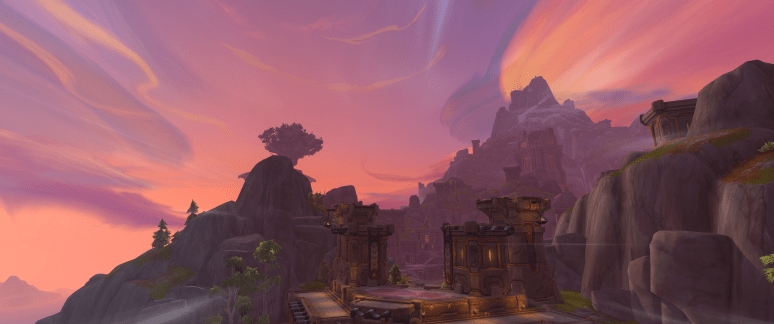
Worldsoul Saga My Ass
The whole point of proclaiming a trilogy of expansions back at Blizzcon 2023 was to set the stage for a grander scale and scope of storytelling, where the events of The War Within would feed well into Midnight whose events will then feed well into The Last Titan, all while picking up where we left off in Dragonflight and acknowledging a variety of plot threads and hanging bits that still remain unresolved. In practice, however, The War Within was a disjointed awful mess of a story that reflects some of the worst impulses of the World of Warcraft narrative team.
Right off the bat, the launch story was a jumble of ideas that never quite coalesced into a whole picture. Dalaran gets blasted for shock value, the Nerubian resurgence and emergence of the Ascended is a vague threat to Khaz Algar that we quickly stomp into nonexistence, and Xal’atath is just kind of vaguely being evil and pulling strings. The Earthen break free of the edicts of the Titans, which is supposed to have huge consequences for them and the isle of Dorn, and yet that only manifests in the form of a singular Titan construct attempting and failing to siege the beach, at which point the Earthen cease being important in any real way (outside of the Archives lore dumps in meta quests, which are interesting tidbits but fail to be represented in the actual story to date). The closest we get to a narrative through-line for the expansion is Alleria, who is drawn deeper into conflict between her family and the presence of the Void within her in a way that is actually interesting and engaging, but we also shelve it for most of the expansion beyond the initial storyline, and even Alleria’s later presence in the story draws less upon those themes. The factional involvement might as well not even happen, because while Anduin gets a hefty helping of story via Hallowfall and his soul-searching with Faerin Lothar, Thrall basically fucks off to start the proper expansion and basically never matters again for the whole story. In fact, the whole Radiant Song premise disappeared pretty quickly too, with only a brief reference to bridge into Undermine and a callback to it on K’aresh with a different Worldsoul’s song!
The patch stories are a similarly-messy tangle of new plots and settings that rarely hit upon any of the launch themes other than a general unease at Xal’atath’s scheming. Undermine, while I liked it as a concept, was a miss as a story beat, because it is neither sufficiently fleshed out on its own merits nor is it connected well enough to the storylines that came before and after, so its attempt at an emotional denouement with the death of Renzik and the liberation of Undermine feels unearned and cheap. Similarly, while K’aresh is a very cool setting, the story just kind of materializes into existence in a way that feels unsatisfying. We learn that the Brokers and Ethereals are the same race in origin, that K’aresh’s destruction was actually the work of Locus-Walker, and then he dies to cap off the raid, another cheap and unearned moment that tries to use the shock value to disguise how threadbare and bland the storytelling is. Locus-Walker is an interesting character but he’s also had relatively little development in the lore and he kind of becomes eye-rollingly stupid in an out-of-character way for the entirety of the patch story, on top of the fact that his bad decision making was responsible for the sundering of K’aresh, so at the point he gets got, it feels kind of empty. The minor patch stories aren’t much better, as the whole mini-revolt in Arathi is kind of an interesting idea and way to keep the factional conflict alive in the story but it also gets undercut as bad actors instead of being an interesting systemic analysis of the ways in which the faction conflict being abandoned in-universe has let old wounds fester and rot. The Siren Isle was so clearly a gap filler that I don’t even have anything to say about it, it quite literally doesn’t matter in any real way and it even is itself a reuse of a never-implemented Battle for Azeroth Island Expedition map which, boy, does it feel like it with how meaningless and insignificant it was to the story, and I even ended up doing it over 50 times for rings on alts!
Now, the logical thing might now be to point at the idea of this grand trilogy and argue that unresolved plot threads are fine if there is a plan to resolve them in the later chapters of this saga, and you know what? That’s fair. However, let’s take a second to really think this one over. Is the possibility of Blizzard resolving these particularly high? I would argue no. The Earthen-Titan link maybe, sure. Xal’atath, probably. But so much of this story was clear filler that didn’t even end satisfyingly – K’aresh has a Worldsoul, but we’ll probably never go back, the Earthen society and the Coreway are almost completely dead plots that they could maybe revive in Last Titan but they forgot about the significance of the Coreway almost immediately after launch, the Nerubians are still maybe dealing with an Ascended problem but also we super squashed that and any fledgling resistance left with the Light’s Radiance team, and then we have to discuss the fact that the Haranir (originally the Harronir but who’s keeping track?) quite clearly had an original prominent role in this expansion that was confusingly delayed into Midnight, given that a significant chunk of the launch cinematic centers on Orweyna and there was originally a whole zone for them that was datamined and never implemented. It is clear that during development, Blizzard gave in to their worst impulses and instead of delivering a new experience with a clear continuity and thought process for the start of their new trilogy idea, did old Blizzard bullshit – a half-baked story that pivoted around in development based on whatever whims the narrative team had from week to week, a bland and inoffensive story that refuses to question the systems and structures of Azeroth that lead to it being this broken and dysfunctional, and a priority for rule of cool ideas like Undermine and K’aresh over logical storytelling with a strong foundation and reasonable narrative continuity. If this is supposed to be the grand return of Chris Metzen’s creative mind to this franchise, uh, let me say something controversial – he probably could have stayed making tabletop games at this point and I doubt it would have impacted the end product in quality in either direction. Not to say I miss the Danuser era, because I certainly don’t – but it also didn’t feel different in any real way. You could tell me that Danuser still wrote this and I’d probably believe it (and given that concept art for the expansion dates back as far as 2021, he might very well have been involved in at least some capacity!), but Blizzard also made a point of marketing this expansion as the grand Metzen return, so I am going to assign that blame accordingly.
Given what we can see on the Midnight beta and of datamining so far, it is also hard to imagine that Midnight does much to course correct this – it seems much in the same vein, with a fragmented launch story that doesn’t satisfyingly tie up much of anything, a slapdash idea of what being the “elf” expansion means in story terms (not saying more to avoid overt spoilers but hoo boy…it’s not good, folks!), and the obvious continuation of a weak villain in Xal’atath while more interesting characters could be used (where is Iridikron? He got tied up in this in Dragonflight and while his focus is the Titans to an extreme degree, I’d like to know more about why he dealt with Xal’atath), it just feels kind of like this grand experiment of a saga is actually just the same old Blizzard writing – empty and unsatisfying at the core but wrapped up in more superlatives and declarations of greatness from a tone-deaf team who clearly doesn’t see how the story is actually being perceived. Which is a shame, because…
The War Within Might Be My Favorite WoW Expansion To Play
Spicy proclamation as the lead-in, oh yeah. Let’s get it.
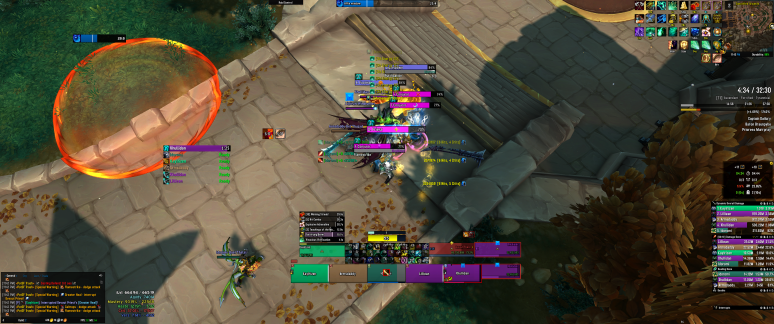
The War Within successfully continues WoW’s “third era” by focusing on the fundamentals of gameplay and content with a more-aggressive content release schedule, iterative focus on the core gameplay loops of WoW that have been established over decades, and the introduction of Warbands making the game the most alt-friendly and approachable it has perhaps ever been. Blizzard has sharpened the focus of the game in this era compared to Dragonflight by pushing to an insane eight-week patch cadence and finally reaching the point of a sub-two-year expansion cycle, so that even as new content may or may not satisfy, the next new thing is coming up quickly anyways, so hey! Dungeon and raid gameplay remain strong pillars of the game, coupled with an increased focus on world content and events, scalable small-group or solo content through the introduction of Delves, and more random diversions that somewhat fit into these categories in new ways (mid-cycle reputations with world events, limited time events like Plunderstorm or Dastardly Duos, and repurposed old content like Horrific Visions) while also feeling new and fresh, even if they aren’t all winners (Horrific Visions have some mixed reviews, and while Dastardly Duos was widely clowned upon, I actually really liked it, haha).
The key has been releasing the game from the Legion > Shadowlands era of maintenance tasks and chores, allowing players to focus on a goal of their choice (gear progression, reputation reward chasing, collecting things, etc) and then providing content that allows players across goal types to do similar or even identical gameplay loops and get out of it what they are looking for. Distilling it down this way makes it sound cold and distant, but that is a very open approach compared to the borrowed power era, where you had to keep up on AP by any means necessary, or Shadowlands where you had to do Torghast if you wanted legendaries and full player power. Just letting you play the game in whatever way you want and then ensuring that way is reasonably well supported is a massive change compared to how it was just 4 years ago and seeing Blizzard largely stick the landing on that as a concept two expansions in a row is actually exciting! We can absolutely quibble over the particulars (PvP players might not feel well supported, not every dungeon season is a winner, world content in patches largely breaks down into a single thing per patch accompanied by new world quests which are just cookie-cutter variants of things we’ve all done hundreds or even thousands of times in WoW) but overall it feels like Blizzard is trying to make a game that appeals to a broad and vastly differing audience and I think that their hit rate is relatively good given that fact.
The Warband system alone is a big contributor here and what I think is the primary win that TWW has over Dragonflight. Playing DF wasn’t bad, but spinning up alts took a fair amount of time and process, even as Blizzard generally kept systems open to make things easier through BoA gear tokens, or currency caches that could be transferred, but the inconsistencies alone made being an altoholic harder than it had to be. The Warband makes the experience smooth with a consistent ruleset for item exchanges, new ways to earn gear for alts via Warbound gear drops in content, shared faction reputation in modern content and slowly increasing backwards to older reps with time, and the addition of perks like the Warband Mentor system experience rewards for having max level characters. Being able to use the Warbank to share crafting materials and keep your account fed with supplies to level other crafters, collect consumables, and just generally share the wealth without needing to camp a mailbox or awkwardly fumble things between characters and factions is a revelation that makes playing so much more enjoyable.
For my personal experience, I found dungeon gameplay great in two of three seasons on offer, and while I found raid gameplay lacking, a chunk of that is down to raid leader stresses and people management for me. The War Within’s first season was marred by some bad design choices, namely in tank tuning, healer tuning, and the ways in which content responded to those roles. Healing was a high-pressure role in all modes of play that first season, and tanking, while still a relatively straightforward role in raid, was made miserable in dungeons through an overabundance of trash mobs with tankbusters coupled with oddball debuff categories that made some dungeons almost impossible to prog well in without certain dispel profiles (doing Grim Batol without a curse dispell was torture, and at least a part of the reason why I gravitated to tanking in Season 2 on Guardian Druid).
Season 2 and Season 3 of TWW were two of the best dungeon seasons I’ve ever played though, as the retuning of affixes and adjustment of scaling in Mythic Plus coupled with the introduction of Triple Threat and Keystone Legend gave higher-tier progression goals that were well worth pursuing. The new dungeons added over the lifecycle of TWW, Operation: Floodgate and Eco-Dome Al’dani, are two excellent dungeon offerings with interesting gameplay, variable routing, and a good level of skill expression. The throwback dungeons chosen, for the most part, were pretty solid – while Grim Batol was a tough choice due to the drake bombing event and the tuning, I think if it had been balanced a bit better, I would have loved it. But all the other throwback dungeons were generally quite good, and it did bring back some fond (and sometimes less-fond) nostalgia to see Shadowlands dungeons again, given that these dungeons were where my pushing and hardcore Mythic Plus play really began. The TWW launch dungeons were a bit more hit-or-miss, because while I like them all conceptually well enough, Stonevault was my most hated dungeon of the expansion mostly due to the Season 1 tuning and not getting to see it again later on, while I would have likely hated Ara-Kara more if it was just in S1 (I wasn’t a huge fan of it generally but the softer S3 version was more reasonable gameplay-wise). Dawnbreaker being fundamentally busted for anything ground placed for most of the expansion was very funny and bad given that they had a ton of time to fix the bugs with airboats and ground AoEs and didn’t fully stick the landing (ha! flying jokes.), while Priory of the Sacred Flame is a dungeon I really liked even though it embodied the phenomenon of “bolt slop” with multiple-caster pulls.
To speak more on the raids, I found the template style of raid this expansion to be somewhat offputting, just because every single raid was 8 bosses with a gatekeeper boss or two leading into a non-linear middle section followed by an end-wing, and that led to a feeling of absence, given that prior expansions have had more raid bosses in more interesting and varied ways. Even Warlords of Draenor had more raid bosses! I also found the lack of unique talent builds for raiding to be problematic, as bosses overwhelmingly favored single-target for the second expansion in a row, so there wasn’t a lot of variety to talent picks or interesting build possibilities, and unlike with, say, Raszageth in Dragonflight, there weren’t bosses where utility talents played a huge role. Maybe having interrupt talented in your raid build for Nexus-King Salhaadar in Manaforge Omega was close enough to count (let’s say sure) but even that is a gap compared to how specifically optimized you could be for Heroic+ Raszageth with interrupts, CC both single and AoE, and other modes of disrupts and stops. The bosses themselves were largely fine, even good to great, but overall I just don’t have as many bosses this expansion that I really came away loving or having a strong positive impression of – Dimensius is close, but watching people die in the first 30 seconds because they finally learn to stand still when goo is under their feet is frustrating to say the least. Gallywix was thematically fun but too simple on Normal and too demanding on Heroic to where I have fewer fond memories of prog, and Ansurek kind of suffers that same problem – very easy on Normal, challenging execution on Heroic, coupled with the fact that Silken Court before her was far more demanding.
The raid zones and trash are fine enough – I hate Undermine traffic with a passion and the entertainment of the gimmick gave way to irritation after the first 3 deaths to cars, but thematically I found the raids varied and interesting in a fun way. The Glory achievements were more demanding this time, with each raid having one boss whose achievement was just incredibly fucking difficult or humorously frustrating – Plexus Sentinel’s rats, absorbing 100% trash per cycle on Stix Bunkjunker, and slimes on Bloodbound Horror demanding every player execute well and find their slime. I still enjoyed raiding this expansion, but it was also often frustrating because of the execution demands on Heroic really challenging my notion that anyone can raid Heroic (and that challenge succeeded, I roster-limited my Heroic team going into Midnight because of the experiences I had this expansion), and this was the first expansion where I felt a need to pursue my personal Ahead of the Curve achievements outside of my raid team so that I could better prepare with hands-on experience to see the pain points of the endbosses and plan more dilligently around them.
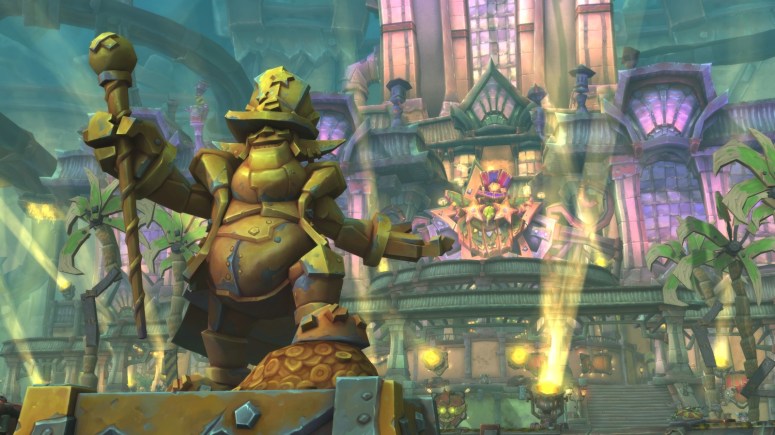
In terms of open-world content, I found the model refreshing this expansion, expanding upon the model Dragonflight implemented with world events by adding mid-season refreshes with additional rewards, a clear structure to catchup gear and mid-tier incentives that was pretty consistent throughout the expansion, and a clear increased focus on making the world of Khaz Algar more active and gameplay-focused, and I think it was good overall. I’m not the biggest open-world content fan, but I play a fair bit just by virtue of having a boatload of high-level characters I want to have some gear and power on and I found a comfortable groove to enjoy in each season and each zone. Some were better than others (I liked the structure of 11.1.7’s Light’s Radiance dailies over the threadbare Siren Isle content), but the overall bar was decently high and varied. I think my only real beef with any open world content is Undermine, a zone that was difficult to navigate due to a lack of distinctive landmarks you could spot from the ground, a faction reputation design that took the good idea they did for Azj-Kahet and inverted it to make it awful, and a poorly-designed secret faction that is an excessively annoying grind in this new era of WoW – all of that on top of removing the new signature “fly anywhere all the time!” approach that Dragonflight brought made it just too much for me. War Mode is something I engaged with more in the open world this expansion as a means of collecting tier sets via catalyzed world PvP gear (and RIP to my methodology given the changes to gear appearance unlocks in Midnight), and I found it reasonably fun even if also a bit annoying at times (world PvP players are often either not interested in conflict or they are assholes who are roving in gangs to kill anyone they can who is just roaming around minding their business, so I guess it is like the old shitty dudes who play rogues and camp people in Classic). The fact that there is a layer of designed content for it is something I found interesting because I did briefly try it in BfA and it mostly felt like nothing outside of chasing crates, but the skirmish zones and FFA objective areas that open up in War Mode are interesting and chaotic when populated.
PvPers in general had a rough time in TWW from what I can surmise, but I don’t really engage with PvP myself, so all I can do is report that I saw an increase in YouTube videos titled things like “Dear Blizz: Please Fix PvP” so man, seems rough for those folks.
In terms of the world design, I feel very mixed about The War Within. On individual and overall merits, the zones are all well-made with varied vistas and interesting biomes that breathe a lot of variety into the game, and that’s good, but the launch zones have a problem with feeling too underground and claustrophobic in a way that felt bad. I never wanted to linger for too long in the underground zones, finding myself retreating upwards into the Isle of Dorn and Dornogal as often as I reasonably could. Undermine is stylized in a fun way, but it also felt bad to navigate from the ground given that lack of distinct visual landmarks I noted earlier in the post, and being stuck on the ground felt very weird for the duration of the time I spent in Undermine – I never quite got over the hump to enjoy it. K’aresh is visually stunning and very open, so good on those marks, but I still feel like it didn’t belong to this expansion and it was slapped in sloppily to offer connective tissue to Midnight and to be cool instead of being cohesive with the theme. It is very pedantic but I cannot help but remark that The War Within, the start of the Worldsoul Saga that references Azeroth’s Worldsoul, ends on a different planet and not Within Azeroth or exploring its Worldsoul in any real way. K’aresh offers such an array of weekly content that I can excuse the fact that it has like 10 world quests total that rotate rapidly and repeat very often (I don’t know the actual number but it feels like the smallest allocation of World Quests to a single zone ever).
Delves deserve a mention here as being one of the best things added to the game in some time. Adding a flexible progression mode you can do solo or in small groups and with its own set of challenges and achievements to unwind is a huge win that a majority of the WoW playerbase can engage with. Not every Delve is an amazing or super fun experience, but I think the overall package was really strong and the emphasis on keeping them relevant alongside more traditional world content is a huge win that WoW’s more solo players haven’t had in a while. Delve progression is even improving in Midnight, so hey, all I can say here is that even with rough edges and warts, I really think they nailed Delves overall and I am excited to see the extensions coming in Midnight.
Lastly, I think we need to speak to the overall design of PvE content and the mechanical density of TWW. I am of two minds about this, especially as we are now in the pre-patch to Midnight whose changes were borne from this design complexity.
On the one hand, as a player who has been growing in confidence and skill, I really enjoyed TWW’s gameplay. There were lots of little nuances and things to learn and I felt like being a nerd and getting into the details really made me the best player I have felt like I have been. I enjoyed the depth of mechanics and tackling the dungeons and raids from different angles and perspectives to see what each role had to offer. I wouldn’t claim to be a world-best WoW player or anything near it, but by Season 3 I was in the Keystone Legend bracket at a point where only 0.5% of players had it on DataForAzeroth (compared to this point where over 20% of players on the site have it) and I had a single-digit weeks to AotC. I felt my strongest this expansion and that made me able to effectively coach willing learners through higher keys, and some of the most fun I had was pushing deeper on alts late into Season 2 with friends.
On the other hand, the complexity of WoW clearly was at a breaking point this expansion. My experience was that I felt more capable in part because I installed WeakAura dungeon and raid packs, multiple boss mods, and a slew of other warnings and finely-tuned addon profiles that gave me an information-packed user interface that could tell me all the things happening at a given moment in a way that I could use in PUGS and that I could coach from in voice chat with friends and guildies. Could I have been as effective with less information and fewer addons? Sure, absolutely, I will say that with confidence (I’ve done a couple pre-patch keys and observed that the knowledge I gained from just studying the dungeons and getting reps in carries over very well even with less info surfaced in-game), but could I have been as effective as quickly? That, I don’t know for sure. A big part of my fear for Midnight is that even as I have fine-tuned my UI into a high-polish, low/no bug state with a lot of information still available, that I won’t be as quick to learn and adapt as I was when my UI could spit out huge warnings and TTS for every major mechanic to come alongside rotation assistance and color-coding for casters. The 11.2 content, though, is a window into the future Blizzard has planned for Midnight, and Manaforge Omega and Eco-Dome Al’dani are instructive as they are simpler overall with less mechanical density but still pose an interesting challenge to players regardless of the level of investment you have into making your UI yell at you like crazy, haha.
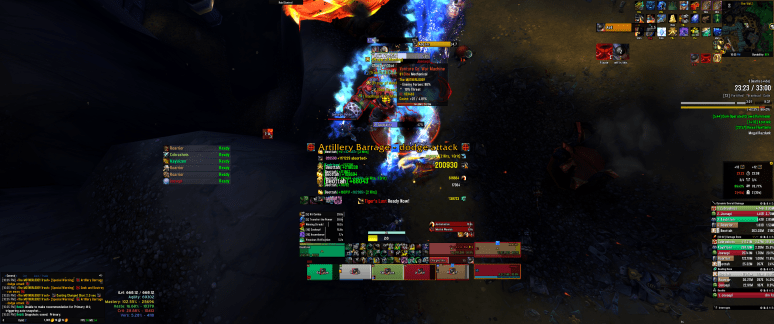
I do think that Blizzard is not wrong to point out that many players have pushed WoW to a higher state of complexity through more addons and more information economy in-game, but I also think that they spent far too long responding by dialing up difficulty instead of intelligently making the game announce things to players and provide strong cues to keep players informed, and some of what TWW represents is them ratcheting on difficulty to an extreme. Discussing their response going forward is the topic of other posts to come and that have already been out, so I won’t stray too far into that now, but TWW was clearly a point where the game had to reckon with the addon ecosystem and Blizzard’s own responses to it from the past, and in some ways, I think the response within TWW was good and in others, it was atrocious. Time will tell what we have going forward.
In Closing
The War Within is such a conflicting expansion for me, because I loved it as a gameplay experience that kept me engaged for most of its run, saw me collect more things, do more achievements, and reach higher than I ever have before, but it also represents the zenith of Blizzard’s bad responses to addons and computation alongside player skill growth, while the story was just not good and felt like a lot of interesting ideas that never got the fleshing out they needed under the guise of keeping things relevant for a three-expansion cycle, a promise that feels increasingly likely to break (based on Midnight beta and datamining, so I could be wrong, obviously). So far, the “third-era” buzz they pushed around Dragonflight launch has actually held true – on the gameplay basis, this is the best WoW has felt to play and enjoy in a long time, but there is a clear opportunity on the story front to meet the promises of the grand saga that was pledged on that stage at Blizzcon 2023. Overall, though? My day to day experience with WoW remains positive and provided content sticks the landing on tuning in Midnight to meet the new challenges of the addonpocalypse, I think it will remain enjoyable for some time to come.
 Kaylriene
Wait, did they really change the way Haranir is spelled? I remember when the allied race was announced, I was like “oh no, have I been spelling it wrong this whole time” so I would love if it wasn’t actually just me being dumb.
LikeLiked by 1 person
It’s hard to find evidence in game, as it seems like by 11.1 they had settled on the change and modified existing data and texts with the new spelling, but you can see a hidden spell from 11.0 on Wowhead that references the original spelling and an article from Icy Veins that also uses the “harronir” spelling!
https://www.wowhead.com/spell=453903/see-harronir-transformed-phase
https://www.icy-veins.com/wow/news/cut-content-what-happened-to-the-harronir-in-wow/
LikeLike
Is it a fair assessment that Blizzard designs an expansion they prioritize raids first, systems and dungeons second, and then story last? (PvP is essentially non-existent at this point in terms of priority.) The more I watch from afar, it certainly seems that way.
LikeLike
I think that’s definitely a popular canard among the audience that doesn’t really enjoy raiding, but it’s difficult to find evidence of that in an objective sense. Arguably dungeons would be the highest priority by popularity now, given that something like 5-6 million characters a season play Mythic Plus at least once (not to mention M0 or lower difficulties) but I think everyone perceives the thing they like the most as the least supported, at least until they remember that PvP exists (which is probably the actual least supported mode of play!).
LikeLike
There’s lots of a deep-dive – and that is why I appreciate your blog in the first place!
But, just one step aside – do you feel it’s Warcraft anymore? I just don’t. Looking back – the last time I felt it, was BfA. The magic’s gone.
LikeLiked by 1 person
Thanks for the kind words!
This one is tricky, but I do still feel like there’s a core bit of Warcraft in the newer stories and content. It reminds me more of Warcraft III era storytelling with the increased emphasis on character plotlines and how those weave into the overall universe of the game, but I think there’s still something fundamentally Warcraft about the way they tell those stories (and not even as a joke to say they tell them poorly, haha).
I do think it is fair to say that the spirit of WoW story specifically is kind of lost, given the haphazard way they ended the faction conflict. That really is a creation of the MMO and I think that while winding it down for gameplay was the best way forward, they haven’t really given it sufficient context or worldbuilding in the game and so it feels kind of unsatisfying how it just sort of evaporated from the current plotlines that way. That is a solvable problem, I think – they’ve got to be willing to spend some time actually digging into the conflict again and exploring why us putting it aside is ideal. It’s a plot drum they’ve banged on a lot in the past with us always banding together against the big planetary-scale threats, so it being put aside even is a Warcraft classic, but there just needs to be more thought put into it.
That’s the big thing I find awful in WoW storytelling now though is just the lack of detail and thought given. I think if they presented things more interestingly and put more effort into that it would capture most of the spirit and be a better story for it.
LikeLike