The first season of Midnight content is in full swing, with the full launch of all 3 raids comprising the initial tier, the opening of the Mythic Plus season, Delves fully opening, and all systems of the expansion now fully operational and in play. How’s it going so far?
Well…it’s interesting in some good and some less good ways. To discuss today, I wanted to start with my progress through the tier and then discuss some of the interesting macro-level issues and things happening as we dive deeper into the new content.
My Season So Far
I had an…interesting season start.
Initially, I was planning to and playing my Demon Hunter, primarily specced into Vengeance for tanking, intending to raid tank and tank keys, and my DH was my most geared character. Due to a confluence of factors (an unplanned healer late on the first night of our second raid week, my general burnout with my raid, a healing gap that was emerging and obvious from our first week of raiding) – I stepped in on my Paladin instead, who has now become my main as of day two of Mythic Plus week. So I pushed my DH to 2255 M+ rating on the first day of season, and then…immediately turned around and started exclusively healing keys on my Holy Paladin, who has, as of 4/1, hit the Keystone Hero level at 2526 rating and been the character on which I have done a majority of my +10 keys and opened the majority of my seasonal portals. This marks the first time I have healed to my first KSH and only the second time I have pushed a healer that hard in early season – in Season 2 of TWW, I did do all +10s on my Druid as Resto for the Triple Threat title, and I’ve mostly consistently pushed my Priest in healing specs (mostly Disc with a TWW S2 run as Holy) into the 2000-2250ish rating range, but this marks a pretty big departure for me. While I could play Protection on my Paladin, and I have both a Prot and Retribution set in close parity to my Holy set, I’ve wanted the hands-on practice with Holy to better understand the interactions and available tools and to ensure I come to raid as sharp as I can be at the spec. It has actually been a fair bit of fun – more potentially frustrating as the healer role often means cleaning up messes and I really want to be able to not have messes so I can be in melee clapping mobs with a shield, but it has challenged my skillsets in WoW in a different way as I am not nearly as familiar with Holy Paladin as I am with many of the other healing specs and so learning the dungeons from that perspective while also learning a new-ish spec to me has been a fun test of my neuroplasticity.
I have done most of my DH keys, however, as DPS, with most as Havoc but a few outliers as Devourer to try it out. Generally, I have comfort with and muscle memory for Havoc, so it is smoother, but Devourer is a fun challenge. It is an “easy” spec in that it has very few buttons in general, but managing the resources, ability alignment, and especially handling downtime and travel time between packs is a huge challenge to doing great damage on it, while it is also substantially less tankier than Havoc generally is – all of which makes it a fun thing to do when I’m doing lower tier keys with guildies. Outside of these two mains, I have done exactly two Brewmaster keys on my Monk – a +7 and a +8. For reasons we will get into, Brewmaster was relatively easy to pick up and run with and the spec is having a strong moment in the sun right now which has made it very fun to play, a stark reversal from when I did main Monk and avoided playing Brewmaster in dungeons like my life depended on it (because holy shit Brew used to feel awful in keys).
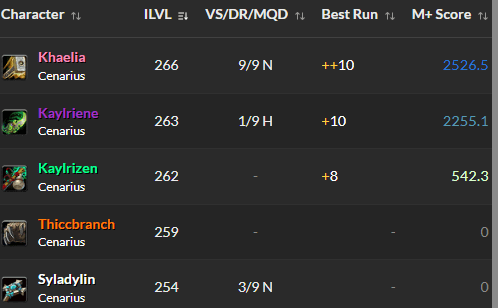
Raidwise, I’ve done a full clear of Normal on my Paladin including this week’s March on Quel’Danas, I did a full week one raid clear on my DH (all of Voidspire plus Dreamrift) and 1/9 H on her (a single kill in a PUG on Imperator Averzian in Voidspire) and my opinion on the raid has both softened and solidified a bit. I do generally like the raids this tier, but I think the difficulty curve is fucking wack – Vaelgor and Ezzorak are substantially more complicated than they ought to be, in my opinion, given that the Lightblinded Vanguard is a piss-easy rollover fight that comes after it in Voidspire, and on Normal, I think that Crown of the Cosmos felt pretty easy in a PUG (3 pulls in week one for me to go from blind to victory) but is mechanically precise, which is a recurring theme this tier. Overall, most of the current fights on Normal feel tuned about right for Normal, are slightly easier as we normalize the addon API changes and combat streamlining, but also have a few pass/fail mechanical checks that mean how you experience the difficulty depends on how good the players with you are at self-regulating mechanics through Private Auras and their own ability to respond – if you’ve got mechanically sound raiders with you, it’s great, and if you don’t…well, it can kinda suck, because there’s not really a good way to coach those players live given how many mechanics hide in Private Auras so that your raidleader can’t easily see them and make calls.
In terms of world content, I reached a point pretty quickly where world quests are no longer really valuable, which is a common trend in this current WoW era, so most of my engagement with the world is weekly events, Prey, and Delves. Prey still feels a little undercooked, but it has a satisfying gameplay loop with Delves that feed into each other – do your 3 weekly Nightmare hunts for a Nemesis summoner and a bunch of Coffer Key Shards, then run your Delves for big rewards. I’ve been doing this loop on all 5 of my current level 90s, with the current item level spread being between 254 (my Priest) and 266 (my Paladin). Prey gameplay seems to have silently buffed progress on Nightmare (or at least got a lot easier with gear) because my average Nightmare hunt time is around 8 minutes, so a full loop per character of 3 Nightmare hunts plus 4 Bountiful Delves takes around an hour and a half per week per character, which is not a terrible feeling time investment at all. Keeping the alts geared and progressing is a good feeling, and while I fully expect that will start to dry up from this gameplay loop in the next few weeks (you naturally hit a ceiling with Delving where you have full Champion loot plus a slow trickle of Hero gear, at which point you decide to focus a character and keep pushing gear up through this loop plus maybe raiding or dungeons or move on), for now it is pretty satisfying and keeping me from moving forward with leveling the alt army, which has been relatively static for the last few weeks (I’ve got stashed Delver’s Call quests on my Death Knight and Hunter and started that process on my original Mage).
Storywise, no spoilers here in this post, but I like how much more integrated the story is this time, both with the raids (having story mode helps but it should be day and date parity with the main raid release in my opinion) and the world. There are updates through phasing that sync up to major plot events in a way that Blizzard hasn’t done as much since they first introduced phasing in Wrath of the Lich King (which was notoriously pretty crazy with tons of phasing all over the map). It feels like there is a real effort to acknowledge the movement of time and plot events in current content that is nice to see. I’ve done the full story minus the final chapter at this point and I have found the story interesting in a lot of ways – which is a topic for another time.
The Macro-Level of Midnight Season 1
The current meta-game of WoW is very weird, to put it mildly. Let’s talk through each of these issues in order.
DPS and Burst Windows
At the high-end of play, DPS burst cooldowns have always mattered. In fact, any tight DPS check requires a strong alignment of burst to pop through the challenge provided. In Midnight, however, DPS specs all generally play pretty tightly to burst windows, where the strong use of burst CDs and buff alignment matters far more than it ever has before in World of Warcraft for most levels of play, and the end result is that DPS outside of burst windows is pretty anemic while strong burst windows can triple or quadruple your output. This creates a scenario in Mythic Plus where pull strategies and routing can actually matter a lot more as key level climbs, because how survivable a pull is for a group depends just as much on the DPS output and kill times of mobs as it does on tank survivability or healer throughput, and if your tank pulls big without a lot of DPS cooldowns available to line up burst, well…it can get dicey even if the tank and healer are prepared as they need to be. Luckily, most burst windows in the Midnight iterations of specs are relatively short, with some being 30 or 60 seconds to cycle through cooldowns, and some specs have major and minor windows based on how buttons begin to align (Retribution Paladin comes to mind, because you get Avenging Wrath, Execution Sentence, Wake of Ashes, and Divine Toll on different cooldowns but they all align in such a way that you have 30-second burst windows with Wake of Ashes and Divine Toll and then on the minute/even-minutes you can align the other two together to create a deathball of major cooldowns that spikes your damage hugely) so you generally have something major to send and provided you understand the interactions of your kit, making burst happen is quite doable.
But it is rather interesting that instead of complex buff-based interactions or major cooldowns with cooldown reduction cycles, the streamlining has largely resulted in rotational abilities with cooldown reduction and centered most of the interaction and synergistic power of specs into these focused burst windows. Hell, even on my Holy Paladin healing, there’s a concentration of power into burst cooldown windows where I can sync up Avenging Wrath with Divine Toll to generate Dawnlights and increased Holy Power generation which allows me to use mana-free spenders more often for bigger bursts of healing (or damage, since you can also send that power into Shield of the Righteous and that also can put an offensive Dawnlight up). Many of the Apex Talents (a topic worth digging into in their own right!) further synergize with this, creating additional burst in these windows that make them often feel mandatory, like how the Havoc DH Apex Talent feeds into Blade Dance damage and rewards an additional Blade Dance right after Eye Beams which is often buffed to Death Sweep due to the Demonic talent, so you’re able to line-up a big AoE (and single-target) burst between Eye Beams and then two Death Sweeps, which can be even burstier in Metamorphosis windows since you can then use Meta to reset the cooldowns on all of these abilities and set up Demonsurges (assuming Fel-scarred is being played, which is pretty typical right now!). Everything in spec design right now puts a ton of power into these burst windows such that your throughput outside of them is often pretty sad looking by comparison, and it does mean that dungeon tempo, pulling cadence, and planning around cooldowns is a high-value skill for tanks at the moment.
Tanks, or Squishes?
With one notable exception we’ll discuss after this, tanks right now feel…kinda bad! Tanking has become an occupational hazard in a new way in Midnight, in both dungeons and raids. In raid, it largely boils down to the loss of DBM taunt alerts, the one part of the job that was immensely automated by boss mods in a way that trivialized tanking for most players outside of the true cutting edge. Without taunt alerts, tanks in raid have to be vastly more communicative and able to effectively coordinate on their own judgement, which is very cool – but also causes teething pains, given over a decade of tank gameplay in raid boiling down to “cycle mits effectively and taunt when DBM tells you to!”
In dungeons, however, the problem is that tank balance right now is kind of awful and being compounded by a community factor outside of Blizzard’s control.
Firstly, right now, most tanks are dealing with Midnight changes that include slight gaps in mitigation coverage. In The War Within, it was usually very possible to have your designated active mitigation ability up nearly 100% of the time, and this meant that incoming tank damage was often very smoothed over without a lot of thought and other damage reduction interactions like Vengeance’s Frailty or Protection Paladin’s Ardent Defender were a little less stringent – you had to be good at the whole kit once the key level climbed high enough, of course, but it wasn’t a big binary pass/fail check in the same way it is now. These gaps create a huge opening in Midnight where tanks can be left a little too squishy and novice tanks can get caught in a very bad spot. The tricky thing is this – you can take talents that reduce this weakness and make you substantially tankier, but they reduce damage dealt by these tank specs, and right now guides on both Wowhead and Icy Veins are simply…not recommending them! Builds on both sites have some major assumptions that favor the damage output builds over survivable, tankier builds, which is probably fine up to a challenging key level or with huge gear, but at this point in the season…not so much! The big examples for classes I have looked at are Vengeance Demon Hunter, where a class capstone talent Demonic Resilience for an extra Demon Spikes charge is skipped in favor of the other-side’s capstone, which gives you…faster Glide speed(!), and Protection Paladin, where a choice node in the spec tree between Avenging Wrath and Sentinel chooses Avenging Wrath, which is pure damage and healing throughput instead of the very-tanky Sentinel talent choice. In the Protection Paladin case, there is a valid argument to be had about the value of the damage gained from Avenging Wrath over Sentinel (it is a lot and with much stronger core gameplay of Prot Pally, you can potentially overcome the gap on survival) but the Vengeance case is very silly to me, given that the value of Gliding faster is pretty fucking low – not zero, obviously, but in most runs, I’m not going to be gliding everywhere for the sake of getting the boost, where I will frequently notice the survival benefit of having two charges of Demon Spikes!
The tanks generally doing okay, like Protection Warrior, are still dealing with peelbacks of some defensive capability like fewer Ignore Pain casts, while Blood DK continues to have the same issues it has had in much of recent history – take damage and heal is only viable if you can survive taking the damage initially, and the kit still doesn’t have strong enough answers for on-pull squishiness to be useful past a key level where the setup on a pull puts you in danger of getting globaled to death, even with changes to Bone Shield and an attempt at smoothing their non-Blood Shield damage intake. Meanwhile, Brewmaster is…incredibly strong!
The Year of the Beer
Brewmaster has often struggled in recent times with Mythic Plus because the design of their mitigation was strong against slower, single-target attacks, but insufficient against lots of smaller attacks at higher speed as you would get in a large trash pull. Their rework in 11.2 during TWW went a long way towards fixing this by creating a choice node for their main active mitigation between the old Celestial Brew (a big absorb shield that stops all damage up to a certain value) or Celestial Infusion (a shield of a slightly larger size that absorbs only a percentage of the incoming damage instead). This change alone went a long way in TWW, because coupled with the stacking dodge chance of Brewmaster’s Mastery stat, the spec is much stronger in situations with smaller and more frequent damage intake, while having a choice node that still provides them with their raid strength. Stagger has always been pretty strong for Brewmaster as well, because smart play with it can reduce incoming damage substantially and even bad play with it slows the rate of damage intake in a way that heavily benefits your healer by preventing you from immediately falling over (although high-enough stagger levels are still quite nasty to see as a healer, oof).
The changes to other tanks this expansion have made a powerful secondary benefit for Brewmasters, who now get to benefit from a stronger dungeon mitigation, a highly synergistic Mastery that gives a direct defensive benefit that scales exceptionally well in dungeon gameplay, a unique gameplay wrinkle that specifically smoothes out damage for everyone with a skill component that can make it highly impactful, and a reasonable suite of self-healing and utility that works very well when a need exists to kite, drop debuff stacks, or otherwise engage in tricky skillful gameplay for a huge net benefit – all of which elevates them over the other tanks. The end result is that while other tanks struggle with survivability and have to make difficult (or easy, in the case of the lolglide talent for DHs!) talent choices to increase survivability at the cost of damage, Brewmaster’s innate tankiness in dungeons greatly offsets the need to make these tradeoffs, and even then, many of their talents don’t have the same level of tradeoff that, for instance, Prot Paladin has with Avenging Wrath versus Sentinel.
However, what is interesting is that unlike other meta-defining things, this feels less like Brewmaster is overpowered in any real sense, and more like the other tanks are just underpowered. Brewmaster feels about right for the current tuning, and still has to be played well to succeed, where the other tanks are far more punishing and require tough build choices and much higher execution once the key level creeps up high enough to just live. So while there’s some animosity towards the spec at the moment, I think it’s also well-understood that they’re not exceptionally OP and that buffing the other tanks will be a better approach (one that Blizzard seems to generally agree with, as during this writing, their April 7th hotfix notes indicate that while Brew is catching two small nerfs, the other tanks are getting significant buffs, save for Protection Warrior because I don’t know).
Healing Whack A Mole
Blizzard has, since Dragonflight, talked a big game about how much they want healing to be a triage game where healers have moments to sit and contemplate how best to keep the party safe without necessarily having to slam on the gas and blast everyone with big heals. Blizzard has, since Dragonflight, utterly failed to balance the game to a point where healers get a moment to think or leave people low because mechanics and incoming damage pacing demand slapping the biggest, juiciest healing button you have when healing is needed because people are getting chunked hard and then you maybe get a moment between mechanics to hit some damage buttons while you wait for the next damage event to drop 2-5 players down below 20% health. Sure, obviously, my example has a hole in it (if you get a global to DPS then you could spend that global and the first one to instead spread out your healing with more available buttons and options), but the general vibe is there – the party is either in imminent danger or cruising and there rarely feels like an in-between. A lot of healing, to be fair, also rests on your group – how effectively they dodge mechanics, use defensives, and such.
The changes in Midnight were intended to, once again, create triage gameplay and open that opportunity up wide for healers to have agency. The problem is that in difficulty-appropriate content, it still just really isn’t the way things work. Instead, what has happened is that the relative value of healer damage has dropped such that filling globals with damage output is not necessarily required, and even when you do, the damage output can be pitifully low (unless you have burst cooldowns that can be burned on damage, like using Avenging Wrath and Divine Toll as a Herald of the Sun Holy Paladin to slam a couple Shield of the Righteous for big damage and pulsing continuous damage output) so it feels somewhat bad. And I mean, if I’m being honest, I think I’m still in a honeymoon phase with current Holy Paladin, because finding those optimization tweaks and having at least one pull per dungeon where I beat the tank on damage is pretty fucking sweet and fun, but as I have climbed into double-digit key levels, it feels less possible, at least with current gear on myself and the party, and a lot of my burst CDs are being spent to quickly top up the party on a huge pull while I might get one or two pity SotRs in as a fun little treat while trying to maintain Judgment with auto-Consecrations.
Balance is an art as much as it is a science, so while I sound harsh to Blizzard, I get that healer balance in particular is tough and I am finding enjoyment with the role either way. But it is quite funny that we’ve heard for 4 years now that the intention is smooth, triage-oriented healer gameplay, and every change made in an attempt to further that goal has instead returned to the status quo of healthbars losing juice like a beer can being shotgunned at a frat party and healers having to dump resources to quickly clean up the mess. Right now, the biggest thing I find annoying about healing is the prevalence of double-magic debuffs that do big ticking damage such that I can only dispel one and then have to sit and heal the second while I wait on dispel CD to return or hope that the affected player hits a strong defensive and can ride it out. If a pull was more centered on those mechanics and reduced other incoming damage at the party level, that could be a close match to Blizzard’s ideal – eye on the tank, eye on the dispels, and an eye on the player sitting with rot damage I can’t immediately dispel (yes I have three eyes, why do you ask?) – but in the current paradigm, it just means there’s a fuckton of damage happening while I also have to babysit a DPS healthbar (or more often my own, since in PUGs given the choice I will always dispel the unknown player and trust myself to play through the debuff effectively), and even worse on the glut of bossfights where a phase or cycle begins by slapping everyone with a huge ticking DoT effect or on the myriad fights this season with heal absorbs as a primary way to increase healer difficulty.
Some of this is down to a secondary issue though…
How Easy is “Too” Easy?
Discussion of this season of M+ in particular has centered in a weird way on the perceived ease of completing keys, and sure, in a comparison between seasons, there is smoke to that fire. Midnight’s first M+ week had 2,376,249 keys run at 10+ and 80.8% of those, 1,920,921 of them, were timed. Compare to TWW Season 3, where 569,453 keys at 10-11 range were timed out of 950,922 total (a time rate of 59.9% even with the smaller and less-difficult key range), TWW Season 1, where just 29,955 timed 10-11 keys out of 80,410 runs were clocked in week 1 – a time rate of 37.3%. Even comparing to what was largely perceived as an easy season, Dragonflight S3, where pre-squish max rewards was at +20 and where the first week saw 142,522 20 or higher keys attempted and only 87,647 of those timed – Midnight season 1 is showing a very high success rate with players easily clearing the bar of +10s in week 1, with minimal gear and still familiarizing with the changes to specs and the addon landscape. There were more timed +10 or higher keys in Midnight’s first week of M+ than total keys run in the ranges I listed above for all of those seasons combined! Granted, some of that is weirdness with what data you can get as a non-subscriber to Raider.IO, and I’m sure if we could get 10 or higher for the TWW seasons it would be interesting, but nearly 2 million keys at +10 or up timed in the first week of a new season and the first season of a new expansion is actually kind of insane.
But that leaves us with the question – how easy is too easy, anyways?
And here’s my take, noting as I tend to that I find difficulty discussion incredibly tedious because it depends on the viewpoint of the individual player and their community and so there is no universally accurate truth of difficulty in WoW nor really in any game or matter and so trying to make definitive statements about challenge is a fool’s errand, but I do think I can contextualize the current experience without trivializing too much: in an infinitely-scaling gameplay mode like Mythic Plus, there is only “too hard” and there is actually no such thing as “too easy” because that just means you must scale up the key level you are doing to match your skill and desired challenge. When Mythic Plus is too hard, as it was seen as in The War Within’s first season, you get numbers like those for that season I posted above – no one wants to fucking play because it feels punishing and bad and generally results in people not having a good time. People do the bare minimum to reach their goals and then peace out, leaving the ecosystem in disarray until balance changes, tuning, or a new season – if some of them even return at all. A season being too easy, on the other hand, means more players onboard and try the content, maybe have fun and keep pushing, get gear and rewards, and everyone can find a happy medium – if you’re bored doing +10s, fine, do a +12 and deal with key level scaling plus an extra 20%, see how it goes. Do a 13, 14, 15, 18, 20, push into MDI, go for title, the sky is the limit – but if a season is too hard, then most players just never enter the content and that is bad for the health of the game. A season being easy means more people play and skill-up, and those players are more likely to keep going into the future and even if a future season is harder, they will be more likely to stick around if the hook is planted by the supposedly “easy” season. In a system like M+, difficulty only goes up, so if the floor is smooth, low, and fun, then more people enjoy it and the ones getting bored just need to pop that key level up until they find the correct stimulus for them.
It’s telling to me that the worst, absolute worst player I know is the only one I actually know complaining that the season is easy and “dumbed-down,” but also can not time a +12 unless he’s in a group being hard carried by his friends who are better at the game. Sure, he can PUG into a +10 and generally have fun, but if he plays with his friends who are less skilled at the game, they’re scuffing +7s, and his skill limit is around +10 with maybe a dabble of +11 with at least one friend to carry, so his complaints about the difficulty (as with many other aspects of the game) ring hollow because even with an “easy, dumbed-down” season he’s still capping out at a similar level to where he always does. And sure, he’ll throw himself at it with more gear and eventually when he’s near the ceiling of 289 item level and there are 3 weeks to go in the season, he’ll probably get Keystone Legend while being carried by his friends and proclaim that he’s so good at the game and a persistent over-achiever, never once re-evaluating his prior claims about this season or his own opportunities to grow while taking the maximum time and resources to barely squeak over the finish line, and I only say that so harshly for this player because my patience for him has run out and he’s kind of a jerk!
So in short – is this season too easy? No, impossible, you can always push higher in Mythic Plus so ease means nothing while difficulty is a limiter for entry that should be constrained at lower key levels.
The Addonpocalypse Revisit Part 376
Addons are super dead, except no they aren’t.
What has largely happened is that WeakAuras died so we could get a million smaller separate addons that used to be WeakAuras, so that Blizzard could try and roadblock the race to world first raiding teams and largely fail, and so that using any addon suite that still works can be made an unnecessarily frustrating experience – and design of raid fights and dungeons hasn’t changed a lot either, so this potential design space that this was supposed to open up is largely not being shown as of yet.
Users of hotbar mods found that on week 1 of the full season, they failed, because Blizzard had a loophole where you could report your hotbar status out to other players and thus track cooldowns – so hotbars were made secret values which completely hosed most hotbar addons for a day or more. Weakauras and proper boss mods died so Blizzard could make fights more interesting but fair – and yet the Mythic end boss has a mechanic you can only about half-see in either realm and that Liquid made a custom assignment mod for anyways that allows them to speed through much of the work, because the time allowed for the memory mechanic is painfully small. Healer frames are still completely missing some very basic functionality and because they now gatekeep what is available for addons to use, those limits also affect everyone and cannot be easily overcome – although options are emerging through various loopholes of different sorts. Blizzard still has an ungodly number of Private Auras in current season content, which primarily impacts the raid but is a general nuisance there that can make dispelling for healers or dealing with certain mechanics a nightmare.
Accessibility remains a core issue that Blizzard has simply failed to fully account for, as a large number of deaf players have reported that even still, there’s just not enough support in the base UI for what they need to play at the same level they were previously. So at this point it increasingly seems like things have been borked for a lot of players to make some wiggle room to tame the RWF players, which hasn’t actually tamed the RWF players and their analyst team’s abilities to build addons that do a lot of things that Blizzard identified as taboo. Not sure it’s exactly been a win!
Issues and warts aside, overall, I am still really enjoying season 1 of Midnight thus far. It’s been fun to push content in a new way and learn more about the game and a role that I used to play primarily, and while there are obviously still some places improvement could be used, it is a decent foundation for the game’s future. There will be things that must be addressed going forward – the tuning of tanks and healers, the gameplay objectives in mind for each role, dungeon design and raid design and how those intersect with tuning and addon changes – all of it will need some tweaks, but the overall base is reasonably good and fun to play.
 Kaylriene