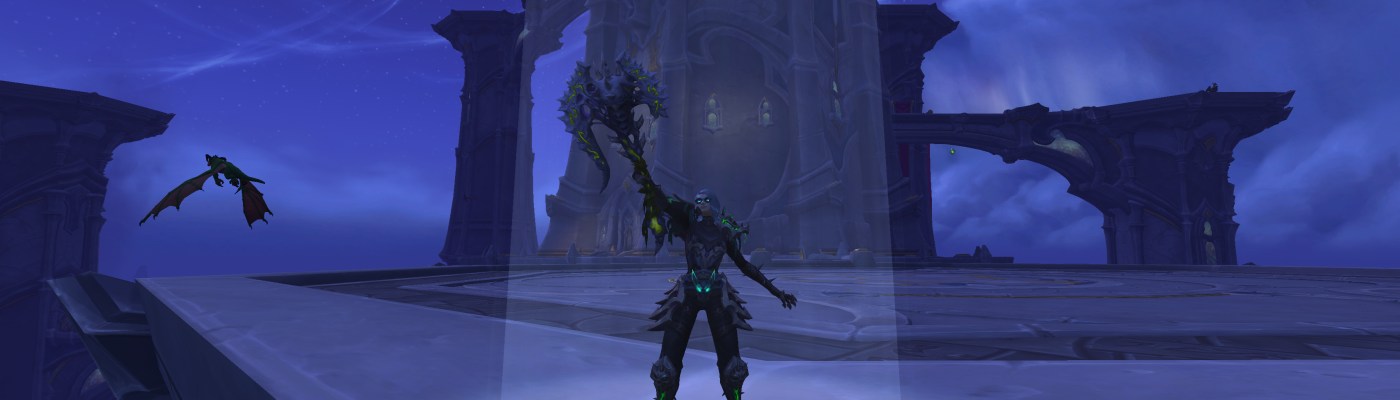
When Heroic Fyrakk came into view for my raid team, a thought had entered my mind – I might need to class switch to make this work.
For my season 3 plans in Dragonflight, I had wanted to take a new class to my first KSM with it, and I had done it with Death Knight. Death Knight, back in Wrath, was my first tank. I haven’t played it a ton, given that in later years when I actually was tanking as a main role I would often go Unholy for DPS instead, but it was my first tank and one I had some passing familiarity with. I took my DK, fully as Blood, to my second-highest Mythic Plus rating in Season 3 (so far). In M+ on my Monk, I vastly prefer DPSing for PUGS, playing Windwalker almost exclusively. My Monk is still, I suppose, my main – she’s 484 item level, has the vast majority of my raiding activity for the expansion and season, and the most advancement through the Dragonflight quest chains, profession skillups, and of course, the only character on which I have +20 portals to dungeons from high key pushing in Mythic Plus.
But after a couple of nights of attempts on Heroic Fyrakk and dealing with adds in Phase 2 in particular, it started to become obvious that something needed to change. On Monk, I have some utility for dealing with the small adds that define the difficulty curve of that phase of the encounter – I can Ring of Peace to displace them and Leg Sweep to mass CC them to stop their casting momentarily, and that is fine enough. However, RoP displacement with these adds is fiddly at best, because you need a nice pack of them tightly stacked that you can push to a bigger deathball using RoP, and on Heroic, the spread rarely allows that. The rest of my raid team has an insufficient number of consistently-available displacements or grips, with my Blood DK co-tank offering the majority of the actual, usable control, coupled with a few Druid Typhoons.
Throughout the season, I’ve been maintaining my DK to a high level, such that her item level was near my Monk (still off by around 6 even now, but above the ceiling of what Heroic drops and above the raid group average, at least), and I was also pushing through PUGs in normal every week trying to get the legendary axe (another story altogether and we will be discussing that later in its own post), so I had a good amount of practice in both raid and dungeon settings with the class. The thought got more intrusive, as we’d already jokingly discussed it throughout the tier – I’d have to switch if I had managed to get the axe anyways, so we were all sort of braced and ready for the possibility, and we had even discussed the ways in which a double-DK tank arrangement would be beneficial to the group. Heroic Fyrakk pushed that from a half-joking possibility to a reality – we needed a change if we were to break through the adds on Phase 2 in a reasonable timeframe, and so I decided, only a week or two into progression, to bite the bullet and switch.
Why that is, though, might be less familiar if you don’t play or haven’t done Fyrakk, so let me step back to explain.
Fyrakk’s fight is a pretty good design for an endboss in that each phase has, basically, one major mechanic that interacts negatively with encounter-wide mechanics to create a unique challenge per phase. In phase one, you have to manage the Wildfire AoE circles and keep the burning from reaching the roots of the tree. In the intermission phase, you need to soak the shadowflame orbs without any reaching the boss. Phase 2’s major mechanic is cycling through 3 sets of different adds – there are Night Elf spirits that must be healed by healers to restore health to the tree (and if the tree hits 0% health it’s an immediate wipe), there are big Infernal adds that spawn on tanks when Fyrakk is inactive, and then during that add phase, Fyrakk does a sweeping deep breath that leaves behind a set of immolated Night Elf spirits that pulse raidwide damage through an interruptible cast and must be stopped from casting as much as possible while being killed quickly. The problem is that while they have very small health pools, they spawn in a line pattern where the deep breath hits, and are very spread out as a result. Normal group and cleave strats don’t work because the adds do not move, even when interrupted, so they must be forced to a grouped location for easy cleave. On Heroic, you also need the big Infernal adds to die quickly, as if they live too long, they eventually reach a full energy bar and detonate on the whole raid for pretty substantial damage.
This is the mechanic that basically makes or breaks the fight. A group with high cleave and AoE DPS can still struggle here because the small spirits cannot just be cleaved down, they must be rounded up. While WoW has added a lot of displacement effects over time, some work better than others, and this is a fight where there is a pretty clear divide between haves and have-nots on displacements. The erratic nature of ground-placed and player-centered displacements add a lot of hecticness to the fight that makes the add phase harder than it perhaps seems. That sets the stage for Death Knights in particular, and especially the Blood tanking spec. Why is that? Well, simple – DKs all have a charge-based single-target grip that can pull one add in directly to the player, a class-tree mass-grip that does damage and constantly ropes suscetible adds into the players range, and then for Blood, the talent Gorefiend’s Grasp, a targeted mass-grip that pulls all in-range targets to the targeted mob. With any two DKs, assuming both have the class talent Abomination Limb, you can pretty reliably manage both add waves you need in Phase 2, and with two Blood DKs in particular, you have a remarkable amount of control and ability to round everything up.
In fact, this isn’t even the first time this expansion where DKs are a godsend, because Dathea on Heroic back in Vault of the Incarnates was much the same with her add mechanic, and there is history at multiple points in the last few years where DK grips make a mechanic substantially easier. While some other specs have options, like Sigil of Chains for Vengeance Demon Hunter, none are as reliable and constantly-available as the Death Knight grip kit.
So, in some ways, I wanted to switch because I’ve been enjoying Blood DK, I wanted a better shot at the legendary from the Heroic encounter, but ultimately, what pushed me to feel like I needed to make the switch is grips. And, in all likelihood, given that we have the rerun season with both Vault and Amirdrassil coming up, it feels like I’m probably going to be locked in on Blood DK for the rest of the expansion as my raid main. I’m fine with that – even excited to try progressing on something new for a final season without the pressure of learning the fights from scratch – but at the same time, I do kind of wish that the encounter design did not force my hand in that regard. It was a choice I was already on the precipice of making for myself just because! – but then there’s the added baggage now of feeling like my hand was forced, and that does add some small amount of negative sentiment.
One thing I hope to see revisited in The War Within is, well, actually two things – class and spec kits around displacements to make them more predictable and easier to use for PvE and encounter design tweaks that make it so fights less often lean on these abilities as heavily.
But until then…I guess I got them grips?


I do the Unholy thing in Fyrakk, and I LOVE the grippiness. I will say that Fury Warrior comes in as a tie for fun whack-a-mole dps class on that fight too (especially with a DK to wrangle the adds into whack-a-mole range).
LikeLike