I’m going to use today’s post to warm up talking about the upcoming content season in World of Warcraft’s The War Within expansion. It’s because before discussing the season, my goals in it, my progress and attainment during Season 1, I want to put forward a theory – the best, most popular Mythic Plus seasons in WoW are the ones that are the most approachable. For that reason, I am relatively hyped for March 4th when the new season rolls out in TWW.
Why would this be my theory? Well, we have some data to suggest this is the case. Zmiecer on Reddit, back in the fall, put together a representation graph using data from Raider.IO to piece together how active seasons were based on a few factors – one is runs per week, which we will discuss, but the metric that blew my mind is unique characters per season. I like this metric analytically for the success of an M+ season because it tells us what seasons are popular enough that people bring alts to M+, and we can see an interesting skew from that. Here is the graph:
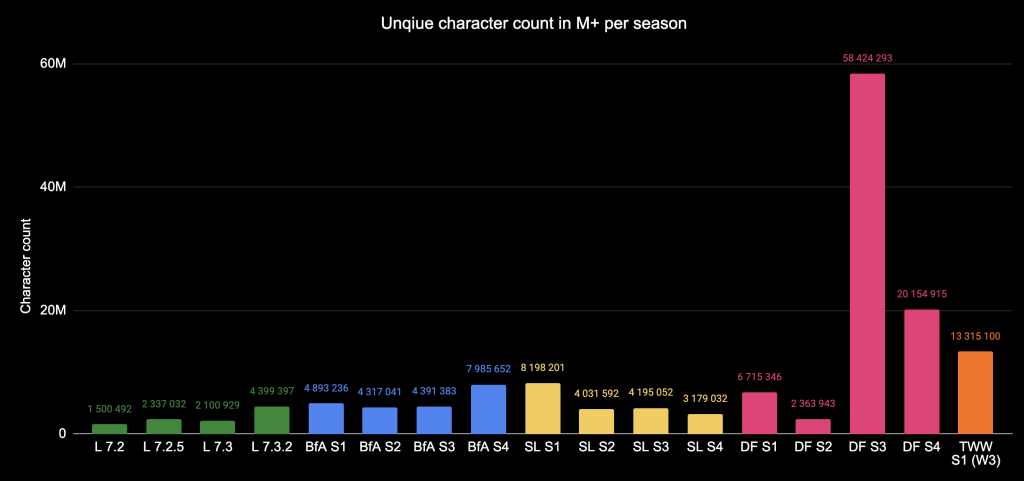
In support of my theory, a few outlier points jump out straight away. Firstly, in Legion (as far back as data was tracked by RIO, anyways), Season 4 during the final patch of the expansion was the most popular by far, boasting around double the player count of the second-best patch during the expansion as tracked. Legion Season 4 was marked with the Netherlight Crucible-added Relic traits, high levels of Concordance of the Legionfall, and easily farmed Legiondaries through the introduction of the Wakening Essence rewards. BFA Season 4 likewise has a huge spike in player population, which could be attributed to overall game attributes of the time (Corruptions, full Azerite powers with Essences, the legendary cape) but also to an excellently-received seasonal affix that people still talk about with the obelisks to skip around the dungeon and define way more free-flowing routes than you typically could, routes that could ease the difficulty points on the dungeons.
Shadowlands is an anomaly, where I’d argue the easiest season was probably the third (the Cypher power ups could make some dungeons substantially less threatening and the return of tier sets plus access to them in M+ meant more power than the weird Shards system in S2 or nothing as in S1), but Shadowlands also had the massive falloff of players in the middle due to long patch cycles, the lawsuit from the CA DFEH against Blizzard, and the lackluster content of SL S2. Shadowlands, along with Dragonflight, also helps me to disprove the notion that a lot of my examples here are due to late-expansion activity – I think there are gameplay factors afoot in why Legion S4 and BFA S4 were popular that aren’t just the migratory patterns of players coming back to a “fixed” expansion that is smooth to play, and both Shadowlands and Dragonflight’s own patterns suggest that it isn’t just a rush of players in the last patch of content, given that both expansions have a substantial dropoff in unique characters between S3 and S4 of their respective content structures.
Dragonflight is where I want to focus my analysis however, because I think it proves my case most directly. Dragonflight’s season 2 was, by these metrics, one of the worst seasons in the game ever. Only the first 3 tracked patches of Legion have lower unique character count than DF S2, which means that every season of Shadowlands had more characters playing, which likely means more players and more activity. The dungeons were regarded as potentially frustrating, an affix rework had pushed a lot of burden onto healers, and retuning of health and damage values globally led to some strange gameplay interactions that did not accomplish their stated aims of fixing healing but instead made numbers bigger and the game more frustrating in Mythic Plus. And yet, the subsequent season, S3, has by far the highest unique character count of any season in history with a staggering 58 million unique characters, compared to the second-highest in DF S4 at a paltry 20 million. The game saw a nearly 30x increase in unique characters playing M+ moving from DF S2 to S3! So what made Dragonflight Season 3 so enjoyable and less difficult? I think we can easily point to a few factors:
-DF S3 was the first seasonal leap of more than 26-30 item levels between tiers, seeing the beginning of the 39 item level season jump we’ve had ever since. This meant everyone could gear immediately and even hardcore Mythic raiders and high-key pushers had immediate upgrades in less arduous content
-DF S3 had a relaxed schedule for the Catalyst to create tier pieces that saw it switch to weekly charges relatively early in the season, allowing players easier access to tier set bonuses and appearances
-DF S3’s dungeon tuning felt easier than most seasons, which some (I am one of those people) attributed to the tuning values against the item level increase, which meant that low-level keys were easy to organize and had a lower overall risk of failure, which allowed more players to farm more and better gear and make decisions to move up the ladder to push harder until they met their own wall
-DF S3’s raid, Amirdrassil, was an artistically well-made raid location with an overall well-tuned difficulty curve for Normal and Heroic that made running with strangers palatable in a way that raiding often isn’t in WoW
All of this is, ultimately, conjecture to a point, and I haven’t done this analysis with a rigorous scientific approach to the data but instead an analytical lens. If you were playing retail in Season 3 of Dragonflight, you probably did a key even if you weren’t normally a fan. You were likely, statistically, to have pushed harder and higher than you ever would have in a normal season. My rating record for a season of M+ was in DF S3, I pushed the most alts through both keys and the normal raid I ever have to date even with half the number of max-level characters I have today, and my overall item level attainment per character was the highest it had ever been proportionally to the content during this season. I had new characters hit KSM and used the season as a training ground to learn how to better play Blood Death Knight, Guardian Druid, and Protection Warrior. More of my guildies did keys, we had several first-time KSMs in that season who did not go on to repeat the challenge (at least as of yet), and we had alt raids and fun runs going almost right up to the next season.
One thing I do need to call out is that for much of Dragonflight (from Season 1 through 3), Blizzard’s deal with NetEase to publish in China was cancelled, which means that some amount of population inflation is down to players from CN realms (who are not normally tracked by RIO unless specifically uploaded to the site) playing on Taiwanese realms instead. I am confident this is nearly a non-factor, however, as the fluctuations in population do not suggest that an influx of Chinese players suddenly appeared on the tracking, especially given that the early seasons with this change in place reflect an average or *below-average* level of participation.
My grand theory then, is this: WoW PvE content is its most fun and engaging when the content is approachable. A season like DF S3 lets you start at a comfortable level of challenge that you can do for fun, but then offers the carrot of more challenge for more reward, and every player can, eventually, find their appropriate level of engagement within a system where the spectrum of available difficulties is as wide as it is during such a season. When a season’s entry-level content is noticeably more difficult, it pushes out a lot of players. It is quite telling that with the Mythic key squish starting in DF S4, M+ unique character participation (and overall weekly runs) have been on a steady decline. In the gap between now and DF S3, M+’s unique character representation has dropped by just over 45 million characters. And sure, you might say, an expansion launched and not everyone went to push 45 characters to max level to open up options, and yes, that is true. However, of those roughly 45 million characters lost in the gap, 38 million of them went missing in DF Season 4, and the number of missing characters in The War Within’s first season is just a smidge higher than the number of total participating characters in DF S1, as a point of comparison.
Of course, it isn’t all doom and gloom, and I write this today because I think there are good signs in the future. Firstly, it should be said that in spite of the precipitous drop in character count I mentioned above, TWW’s first season is the third-highest by unique characters since Raider.IO began tracking the data in Legion, so while it is a huge dropoff from prior successes, it is hardly the gutter or rock-bottom. Secondly, TWW’s first season of M+, while it was overall pretty dreadful, wasn’t necessarily bad. It was absolutely not what it should have been, but I think comparing it to previous bad seasons like S1 of BfA, Shadowlands S2, or Dragonflight S2 shows that a few small tweaks could have made it much better – and while Blizzard did make some of the necessary tweaks on the reward side, they came far too late in the season to save the waning interest, coupled with Blizzard not making enough tweaks to tuning both in the dungeons and with class and spec design.
But the biggest hope I have today is for Season 2 of TWW, and there are a few reasons for that. One is that both tanks and healers have received some changes that address some of the deficiencies that defined Season 1 – tanks are a little bit tankier, capable of higher damage output, and generally more enjoyable in the coming season, barring some weird exception cases (the changes to reduce Protection Warrior APM makes it a little less fun to play, in my opinion). Healers have been generally tweaked in decent ways as well, including a couple of large-scale reworks – they’re also the most at risk of being the burdened role that ends up under-represented this season, but we can’t say for sure yet. Another good reason to be excited for next season is the onslaught of easing measures taken by Blizzard to make Mythic Plus more approachable. They’ve made some additional improvements to reward structures for the mode, eased the difficulty curve by frontloading a larger increase in scaling and then making each key level a smaller step up from that higher initial step, moved around affixes in a way that means low-level keys are literally affix-less, removed trash tankbusters and increased cast times on interruptible abilities, and then in the twilight hours of PTR, reduced the health of mobs in M+ by 10% globally which means that combat duration should be lower overall and gearing your character will substantially ease Mythic Plus as you progress, since you can bring down threatening mobs much faster.
So far, the feedback on PTR has been fairly positive. More changes could come, sure, and maybe more will be needed when the playerbase writ large gets their hands on Season 2. But there is a light at the end of the tunnel that has been TWW S1, which is that Blizzard has made improvements based largely on player feedback. The overall design ideal at the heart of the season has touched on a lot of the pain points that TWW S1 had, which makes me feel hopeful that it will be a good season. Dungeon tuning has seemed promising, and while there are more steps I would like to see (more look-in at tanks and maybe peeling back some of the initial TWW tank nerfs), the overall seasonal direction seems good.
So my hunch is this – the tuning will make TWW S2 approachable, which will increase unique character representation bearing benefits for the system at all levels as more people get into it and play, making finding groups and pushing higher easier to do and more likely to happen as a result. Players wanting that nail-biting challenge level will have the ability to get it by pushing higher and I think players at all levels will find a suitable place to rest in the high-end content ecosystem of WoW during this season.
As a last bit of support for my theory, I think we can point rather easily at the success of Delves in S1 of TWW as a point in favor of lower difficulty, approachable content. Delves were, at least in terms of overall playerbase perception, wildly successful as an endgame pillar that drove people to do something distinctively endgame flavored but that didn’t require the rigamarole of doing dungeons or raids. Delves, like M+, also offer scalable, granular difficulty, albeit in the case of Delves with a limited ceiling, but then Delves also take less time, can be done solo (and provide a fun progression challenge for doing so up until the S1 designed rewards endpoint at Tier 8, after which tuning imbalances and role advantages become far more prevalent), and, perhaps most crucial, Delves provide powerful endgame rewards unlike so many other prior attempts at endgame pillar content from Blizzard outside of the dungeon-raid-PvP trifecta. A big part of the TWW S1 player representation equation is tied up in Delves – Mythic Plus being overly difficult and more cumbersome than usual didn’t simply drive the missing players out of WoW, but pushed many to alternate gameplay options, like Delves. A point I’ve argued repeatedly is that the issue with S1 was that rewards in low keys weren’t commensurate with effort, because Delves often asked less, at least slightly, but gave substantially more for the investment. I can only directly speak for my own experience, but I spent less time in keys in S1 of TWW and far, far more time in Delves, especially because I was able to kit out a lot of alts in normal raid-level gear solo with relative ease while also feeding an account-wide goal of progressing my Brann level and the Delver’s Journey for rewards. I’ve been doing more keys than delves as of late, but even with that, my experience has generally still been that up to a decently high progression point, Delves have been simply better and often easier to start, if not always completely more enjoyable.
In the end, a lot remains to be proven when Season 2 actually begins deploying on live servers starting on March 4th, but I’ll stand by my call – if the season turns out to have that nice, buttery-smooth difficulty curve that allows people to onboard successfully as was the case in Dragonflight’s third season, that is a recipe for success.
 Kaylriene
Thanks for writing up this thoughtful analysis of TWW Season 1 Mythic Plus. I’m someone who gets Keymaster relatively late in the season along with a few portals, but doesn’t push much more than that. I did make it to 2500 in DF Season 4 and TWW Season 1, but that was mostly due to a big push at the end when I had the best gear I was going to get.
TWW Season 1 felt different because my guildmates and I spent the first few weeks in Delves. When we started running dungeons, we didn’t know the new ones and it really showed in our unfamiliarity with the dungeons.
But the bigger issues were what you described: (1) the jump from Delves Tier 8 to the corresponding Mythic Plus dungeons in terms of desired rewards and (2) the dungeon level squish. When Blizzard announced they were going to squish the dungeon levels in half, I thought it made sense. But in practice, it made the jump from each level so much harder that failure became more frequent. It’s the equivalent of me starting out with a 5-pound bicep curl and going to a 15-pound one without a midpoint at 10 pounds. (Silly analogy!)
ICYMI Icy Veins has been writing a series of posts about Mythic Plus participation with some interesting data analysis:
https://www.icy-veins.com/wow/news/a-good-mythic-start-to-season-2-complete-week-1-run-numbers-and-completion-rates/
https://www.icy-veins.com/wow/news/regional-mythic-season-stats-chinese-player-additions-change-the-numbers/
Great blog, always look forward to reading your posts!
LikeLike