
The benefit of writing drafts and then sitting on them is I don’t put out wildly incorrect takes, but I am going to peel the curtain a bit and discuss how the recent announcement of Ghosts of K’aresh caught me off-guard.
K’aresh is Cool…
As a finale patch zone, K’aresh is a great zone. I had the opportunity to check it out on PTR and do some questing there, and while the questing is bog-standard WoW, the zone atmosphere and setting are easily 10/10. It looks like a sundered world and feels like one, but unlike our last foray to such a world with Argus, flying is there from the jump so you can navigate around with ease. The design aesthetic of this zone gives Blizzard a chance to revisit and revise old Burning Crusade visuals around Ethereals, with new eco-domes that combine aspects of Zereth Mortis with the original bright pink barrier magic to make something that looks really cool. Likewise, the raid being a large manaforge looming in the distance gave a chance to revisit that particular idea from Netherstorm and to make it higher fidelity and much cooler. K’aresh’s main landmasses are covered in white dust that adds that feeling of desolation and destruction – it feels in many ways like we should not be here or able to survive here, and yet we do. The number of different enemy types roaming the open world is great and there’s a good visual variety so not everything is just void elementals or Ethereals – it also allows the return of a lot of TBC-era world mobs like mana rays and phasestalkers. Tazavesh gets a little visual update, mostly because it was a dungeon before with no flying so it now has proper roofs and trim up top to make it visually continuous. Moving it to K’aresh is great because Blizzard did a quality of life thing here too – the portal to Tazavesh for Season 3 Mythic dungeons is located in K’aresh in exactly the same place in the city it was for Shadowlands.
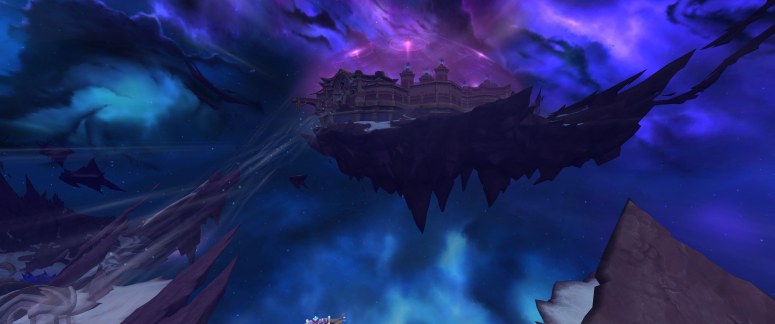
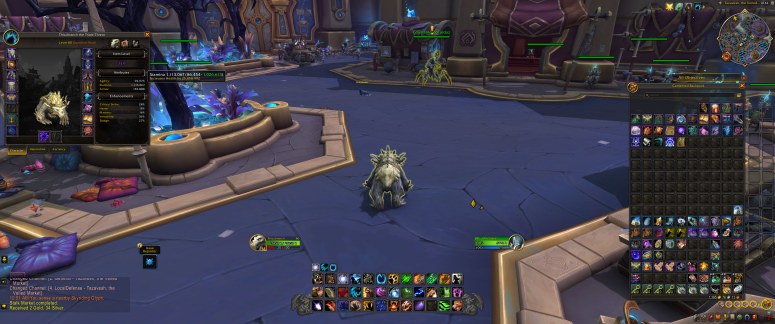
K’aresh adds new herbs and ore to gather with Phantom Bloom and K’areshi Ore, alongside higher-level versions, both of which exist solely to allow for bartering in Tazavesh to exchange for existing Khaz Algar reagents. As a tradeskill extension, this is fine enough – the revamped profession system since Dragonflight struggles with adding new reagents given the continual value of the original recipes so adding a flavorful way for us to get reagents and stay in the new content is kind of neat. The zone is full of standard WoW world fare, at least so far – while I haven’t seen World Quests, I expect them to show up eventually, and in the meantime there is a roaming world boss, rare mobs, treasures, and even Skyriding glyphs just hanging out all over the zone, giving it this constant pull of attention as you fly through the skies between the desolate shards of the Ethereal (and Broker!) homeworld.
For all of this, I like K’aresh a lot so far. However, I do need to discuss something about the zone related to my incorrect and unpublished prediction…
…K’aresh is Also Rule of Cool, Which Is Less Cool (Maybe)
In the story of The War Within, going to another world feels distinctly…less Within. The War Without? I dunno, we can workshop that later.

In terms of the story being told within the expansion, K’aresh makes little sense, at least so far. It was simply teased during the finale cinematic of 11.1’s story content, and while we’ve had the increased presence of Ethereals roaming around, it feels rather left-field. In that draft post I was cooking up, my major contention was that while a normal WoW expansion would use that K’aresh hint as setup, we had too many loose plot threads hanging back in TWW territory – what’s the Deepgrove, who exactly are the Haranir and where do they come from, what’s going on with Anduin, and the most important question, one we were told would be answered back at Blizzcon 2023, where in the hell was Sargeras actually stabbing and what was he stabbing at when he plunged that sword into Silithus at the end of Legion? There was datamining back in TWW beta that suggested that during leveling, we’d actually have five zones, with a zone between Hallowfall and Azj-Kahet called the Rootlands, which seems to fit in-line with the Deepgrove flavor items we still have lingering in the game today as Herbalism knowledge boosters and also seems to track locationally with a good approximate location for a sword-stabbing while also having a theme and flavor that fits the Haranir to a tee.
To me, while I know why K’aresh matters to the current story (Xal’atath was once Dimensius’ Harbinger, heralding his coming to and destruction of a world, Locus-Walker treats the threat of Dimensius very seriously, we’re about to enter a whole void expansion after this), it also kind of felt like it would fit much better in Midnight. Obviously, that’s without the full lore hooks to come in 11.2 and its minor patches, so who knows what that might hold, but it still feels weirdly out of place. The biggest mention these topics have actually gotten outside of the pre-patch content is in Lorewalking, which increasingly feels like it was hastily added to 11.1.7 as a way for players to see the Ethereal story and Xal’atath’s origins so we could be caught-up before the patch. This also kind of raises questions about what the Lich King Lorewalking scenario is a setup to, and given that Northrend is supposed to be our playground in The Last Titan, perhaps Blizzard is doing some heavy foreshadowing here!
I like K’aresh, I really do, and so far I think it is a great zone and an interesting-enough story on its own. But it also feels shoehorned in here and not like a completely organic direction this plot could have taken of its own volition, which I don’t like as much. K’aresh is probably cooler (for a given definition of cool) than the Rootlands concept or a Deepgrove raid would have been, and that’s fine enough, but Blizzard loves to get lost in the weeds when they do rule of cool stuff, and it is hard not to see the pivot to K’aresh as them losing sight of the overarching 3-expansion narrative they themselves committed to. The structure of a saga is a means to let stories breathe, but given that each entry is still a discrete story in its own right, I am disappointed that TWW feels increasing less like a self-contained product with natural, well-flowing plot connections to feed into the next part of the saga and more like a dumping ground of exposition before the real story begins.
On A Gameplay Basis, 11.2 Is Interesting
11.2 is making a lot of tweaks and modifications to the core formula that has, overall, succeeded so far in The War Within. The season starts with quest catchup gear to bring story-only players up to par, Heroic and Mythic dungeons use the seasonal pool for Season 3 and upgrade reward item levels in accordance with that, the raid is 8 bosses on the nose with some route choice options available, and I suspect that we’ll see catchup gear mechanisms in 11.2.5 and 11.2.7 that allow players to get pretty high up the power ladder without ever entering a raid or dungeon prior to Midnight, and all of that is great. The changes are fascinating, though.
From a player power perspective, two major changes to gear are in play. Firstly, to account for the six item level inflation that was offered mid-season in Season 2 from Turbo-Boost, the item level jump tier-to-tier this time is 45 item levels instead of the 39 we’ve had the past several seasons. Granted, this is still a 39 item level jump over Turbo-Boost, but it also means that Turbo-Boost was not just a Season 2 inflationary measure but indeed a proper inflation to the item level curve of the expansion as a whole. Because Blizzard has already confirmed that Midnight will have another stat squish in interviews around Blizzcon 2023, this is perhaps not a huge surprise or shock – it will indeed be a temporary blip to untold heights of power before everything is scaled back down aggressively in 12.0, but it is also fascinating given that scaling in WoW has grown so out of hand that we are around 250 item levels lower and 30 character levels lower than we were at the end of Legion (our highest point of scaling prior to TWW) and yet we have nearly 3x the stat values in terms of health and throughput. Blizzard’s decisions around stat scaling and squishing of values are fascinating to me because the solution they settled on in squish two, where items scale up in power at 1% per item level (which means that higher item level values scale higher per item level due to multiplicative scaling value), has kind of led to an interesting dilemma where we reach even higher levels of power than we did pre-squishes at lower item level values. What I am curious to see at this point is how Blizzard handles squish number 4 in 12.0, because while the current model is workable enough (we lasted 3 expansions on a combined level/item squish, after all), I think there could be some fine-tuning that might arrive at better outcomes. Would those outcomes be as fun in terms of power creep and numerical scaling in benefit of the player, though? I think that is the real challenge and I won’t pretend to have any answers to it!
Secondly, something that Blizzard nearly did at launch of TWW, but held off on, comes in 11.2, with tier set bonuses now being built for Hero Talents instead of just spec. This means that functionally, every spec has access to two different tier set bonuses based on their Hero Talent choice, and each Hero Talent tree has slight modifiers to tier bonus for the two specs that sit under that shared umbrella. This is…an interesting choice with some caveats. For pure DPS classes, this isn’t that huge, although the tier set strengths and weaknesses might push one set of Hero Talents over another, which is already functionally the case for many specs as-is under the current system. For Hero Talents that share with tank or healer specs though, it becomes a real dilemma at times. A lot of Tank/DPS bonuses are pure damage which is just less effective for the tank spec under that Hero set, or they tack on Blizzard’s favorite tank tier set trope of random (and therefore largely unhelpful) defensive procs, and a lot of Tank/Healer Hero bonuses fall into generic buffs to Hero abilities, which are wildly apart in terms of actual power even sometimes on the two specs that share that Hero Talent! Like with this current Season 2 tier, Blizzard’s attempts to homogenize tier bonuses lead into a trap where the effort spent on making more widely applicable set bonuses leads to disproportionate balance and some problems. It’s still in the PTR cycle, so there is time for things to be ironed out, but I think the challenge is that testing every possible variant of a set bonus is going to be a real challenge in cases where some specs never play one of their two Hero Talent choices, like Retribution Paladins and Herald of the Sun, or in cases where the Hero Talents lend themselves to play in only one mode of the game, like how Guardian Druids play Druid of the Claw only in raid where the single target damage boost is worth the tradeoff while Mythic Plus is almost exclusively for Elune’s Chosen.
One other loot-adjacent thing that is somewhat new this time out is a lack of Very Rare items. On my last peek at the dungeon journal, there was exactly one Very Rare for all of the Manaforge Omega raid – a two-hander strength/agility mace whose unique effect was not a performance boost. It seems like Blizzard is moving in the direction of mini-sets, with the Voidglass set being a thing that casters can pick up that offers a decent power boost, and also more movement in the direction of bonus loot items that are personal-looted to players, like the boots from the DH council fight that buff the effect of the Artifact cape being added in the patch. This is an interesting move, because on the one hand, mini-sets and chances at personal loot with some power is a nice twist compared to the frustration that could result from Very Rare items and their droprates, but on the other hand, moving in this direction does further dilute the value of raid for loot to a more balanced player who enjoys both raid and dungeon gameplay. This season, dungeon-only players were often frustrated by Very Rare raid items and their dungeon viability, which led to increased calls for the Dinar system and also forced a lot of high-key pushers to try and tag along on Mythic raid kills so their Dinar purchases could include Myth-track versions of powerhouse items like the Jastor Diamond or Eye of Kezan. At the same time, besides tier set acquisition easing, Very Rare items were kind of the only thing that was making the archaic raid loot system in WoW feel valuable, and now…well, for Mythic raiders, it will remain valuable as a reliable source of Myth-track item drops, but for the general population of the game, I suspect the lack of value of raid drops in relation to the farmability of Mythic Plus will continue to make raid feel less worthwhile from a player power perspective.
Last-Tier Capes
Blizzard is, in the last tier of an expansion, adding a cape that you farm power for and offers you increased power. Is it 2013/2019 again?
The Reshii Wraps is a back-slot armor item that you get early into questing in K’aresh, designed to allow you to turn into pure energy for evading certain mechanics, see new mobs, and enter the raid as an infiltrator. It’s a neat concept only partially sullied by the fact that an end-tier high-quality cape is a trope that Blizzard has repeated twice before this, with the Pandaria legendary capes and BfA’s Ashjra’kamas. At least this one is only (only) Artifact quality though! Jokes aside, it isn’t a bad concept, although it is now the third time this expansion where we’ve had an item with grindable power upgrades dangled in front of us, and at this rate I would not be surprised if 11.2.5 or 11.2.7 introduces yet another similar concept.
The cape is a bit iffy for a few reasons, key among them that it can only host a single secondary stat of your choosing. Instead of itemizing it with a selection of stats or no secondaries as the previous borrowed power grind items this expansion did, you instead get a Fiber slot to insert a secondary stat of your choosing (and also to keep you regular). There’s also a buff based on your role, which means tanks get a boring damage absorption effect instead of being able to pick a damage proc (even at reduced effectiveness) or a boring stat proc (which would at least have a chance to add both offensive and defensive power), healers get a healing proc (random healing which generates a shield if you overheal with it, oh boy!), and damage-dealers get a random blasting Arcane proc that hits in an AoE, which at least is kind of exciting and central to your goals.
As an idea, the Wraps are fine. They unlock additional gameplay tweaks which is neat, and while I dislike having to choose only one secondary stat, given that we’ll be in big diminishing returns territory this season as-is, this is probably fine since you’ll be able to pick your preferred secondary and keep a balance that allows you to soft-cap on preferred secondaries without too much hassle. The distinction of Artifact quality versus Legendary is a bit iffy (is it just Artifact because it has its own node-based progression system? That’s actually it, isn’t it?) but it is intended in much the same way as prior Legendary capes at the end of a given expansion were – a big shot in the arm of power that will excite players who do lower-tier world content while for dungeons and raids it will be an optimization vector around which you can strategize. The wrinkle of things like hidden rooms and challenges you can face specifically with the phase-shifting the cape allows is a nice twist and one I am excited to see used intelligently.
Season 3’s Dungeon Pool
Season 3 uses the results of the spring poll conducted by Blizzard, bringing a dungeon pool where the TWW-half is from fan vote, consisting of The Dawnbreaker, Ara-Kara City of Echoes, Operation: Floodgate, and Priory of the Sacred Flame, all pretty much voted upon because of the exceptionally good trinkets dropped in each. For the throwback half, similar to Season 2 of TWW, we get one brand-new dungeon in Eco-Dome Aldani, but then 3 Shadowlands throwbacks in Halls of Atonement and the two Tazavesh wings. This pool is interesting because in some ways, it makes a lot of sense (Tazavesh is our homebase in K’aresh so the dungeon being back is obviously a simple play) and the new dungeon was something we were told would be happening back with the 2025 roadmap for the game, and in other ways, it feels a little weird (what is the connection or theme that Halls of Atonement shares with the current patch and story themes?). The polled dungeons are also kind of weird, because while the loot perspective makes sense, the dungeons are somewhat polarizing. Dawnbreaker was a buggy mess for all of Season 1 of TWW, where sometimes you couldn’t stick the landing on the boat because the game would clip you through it, Ara-Kara was a favorite because of the loot and its shortness, Floodgate is a very open dungeon with a lot of routing choices but also difficulty that makes some players dislike it, and Priory is probably the hardest overall dungeon in Season 2 and something that even veteran key pushers don’t seem too enthused for.
One thing I find fascinating is that a lot of changes are being made even to the TWW dungeons in the pool. Priory of the Sacred Flame’s first boss has a brand new mechanic replacing the spear throw that can eventually crowd out the encounter space with earthy void zones, the annoying stun mob in the last stretch of Ara-Kara is gone, and while not a TWW dungeon, Halls of Atonement has some huge boss changes on the last boss and also some interesting tweaks to the stairs in the courtyard that seem designed to force us to play with those rotating gargoyles we used to skip all the time in Shadowlands.
Overall, though, I actually kind of like this pool. Floodgate is a dungeon I actually have come to like, Priory is fun thematically and has some ridiculous fun for tanks in the crazy pulls you can do, Ara-Kara is short and mostly inoffensive, and I really like Dawnbreaker for the length of the run and the minimal amount of trash you have to deal with, even with the bugs it still has almost a full year post-launch. Shadowlands dungeons have been over-represented in the throwback pools this expansion, but I think there’s a simple reason for that – they’re some of the best Mythic Plus dungeons around and they were almost so good as to erase the negatives of Shadowlands gameplay loops outside of them, and anything that could make anima-grinding, Torghast repetition, and Renown v1 pushing bearable is strong in my book. I’m very excited to try all the dungeons with the tweaks and changes that have been made for Season 3 and to see how the seasonal balancing works out. Blizzard has stated that Season 2’s balancing went well and obviously resulted in a lot more keys being done and much higher pushing thanks to tuning and the Resilient Keys system, and I definitely had a lot more fun in Season 2, so here’s to hoping!
Manaforge Omega and Huge Boss Models
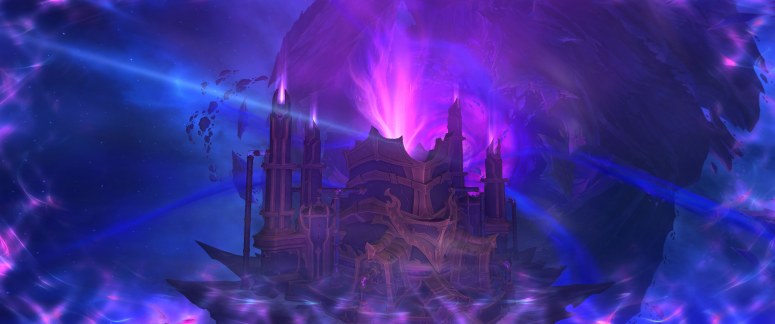
The final raid (that we know of, at least) for The War Within is 11.2’s Manaforge Omega, an 8-boss run through the massive mana intake facility on the edge of K’aresh. Within its confines, we face off against a mix of bosses, including the wrap-spinning moth-like creature that makes the wrappings for Ethereals, a sentry robot, a council fight of Demon Hunters that represent the two existing specs and seemingly hint at a third, Void-based spec (all of the abilities for two of the DH council members are literally existing DH abilities scaled to raid-boss levels), and a final two bosses that reprise some quests from The Burning Crusade, with the return of Nexus King Salhadaar and Dimensius the All-Devouring. Unlike in TBC, however, we are not facing a shard of Dimensius but the full-fledged Void Lord himself, with a boss model size that is larger than the city of Stormwind.
This raid, at least from early testing and the Dungeon Journal, is a raid. There are some novel mechanics and ideas, and they look pretty cool, but at the end of the day, the formula in TWW has kind of stifled raid design. You get 8 bosses every time, with omnitokens off the last boss, no tier from the penultimate boss, and tier tokens earlier in the raid than traditionally has been the case. There’s some route variety in terms of boss order around the midpoint but otherwise the raid will have a preferred difficulty progression and route that most groups will follow. Visually and in terms of the unique mechanics I’ve seen so far (I haven’t played testing on PTR and probably won’t), there’s some cool stuff going on there and I think the raid will be pretty neat after the repetition of Liberation of Undermine using the same environment as the zone of Undermine for the majority of the raid. In terms of gear aesthetics and the overall theme, it is very strong and I like it a lot, although my secondary fear with K’aresh coming now is that the void aesthetic will be too repetitive with Midnight coming right after it.
I say all of that and yet I am genuinely excited for the raid – it looks cool, but I do think that raid has fallen by the wayside in general in TWW. There has been a two-expansion stretch now where basically most raid fights use single-target raid-ready specs with few gameplay changes, where tank mechanic design de-emphasizes survivability in a way that is rarely subverted (some busters like Pyro Party Pack on Sprocketmonger Lockenstock have hands, but that’s exceedingly rare), and where most healer gameplay is built around steady and largely predictable ramps which take some small amount of flavor out of things. However, at the same time, the scale and feeling of WoW’s raiding remains great and it is an enjoyable in-game activity.
The Release Date Is Too Soon?
Blizzard has confirmed that the patch date would be August 5th in the US and rolled out with the weekly reset that same week in each region, which beats their 8-week patch cadence in TWW by 1 week. With a standard 1-week seasonal delay, Season 3 in full starts the following reset the week of August 12th, albeit this time Mythic base dungeons (minus Tazavesh) will be available during patch week, with Season 3 Champion-track gear dropping as they will continue to throughout the season. This has prompted the question from some – is it too soon for a patch?
I think in The War Within, what has been interesting is that Blizzard has, in many ways, tightened up their release cadence compared to any prior point in time. Legion was the prior gold standard for patch releases, and those were more sparse patches on an 11-week window. TWW has been 8 week windows, more total content per patch, especially when accounting for the minor patches like 11.x.5 and 11.x.7, which now feature an hour or two of added story content, additional catch-up mechanics, and oftentimes more features and content beyond those things. Granted, not all of TWW’s patch content has been a hit – the Arathi questline in the recent minor patch has been a letdown, and Siren Isle was artificially elongated by gating power progression behind locked quests that rolled out weekly – but generally, Blizzard has made a concentrated effort to have content in the game for people to play and to make it so that mid-season lulls aren’t just opportunities to redirect players to Classic – the retail game has a steady stream of things going on.
However, to an extent, it can feel at times like there might almost be too much to do in retail, and that’s a double-edged sword. Effectively, it answers most critiques of Blizzard’s content structure for the game – the team has never made more stuff to do for players and they’ve done a good job of incentivizing playing that content without making it too crazy. Sure, Corruption head enchants are helpful now but they literally stop working in Season 3 so there’s no need to excessively grind to get them or keep a stock of them on your characters, Dastardly Duos was…a thing, but it’s not at all an activity you even have to touch unless you want the cosmetic rewards or to farm mid-tier Warbound gear, and then there’s the drip-feed of story content, stuff like Lorewalking, and more. In spite of the very optional nature of much of this content, however, it does create a perception of a laundry list of things to do, which can be a bit of a problem to many average players. For someone like me, Horrific Visions were required to get that last ounce of player power for late-season pushes and AotC with my guild, Dastardly Duos wasn’t particularly great but it was kind of a dumb fun thing a group of us made the effort to do each week, and keeping up with story content and the other additions was an interesting way to fill out some time, and I get how that can be overwhelming. Right now this week, we have the Winds of Mysterious Fortune event back, the third week of massively increased transmog and rare drops from legacy content, Horrific Visions for those still chasing goals, Turbulent Timeways, normal weekly meta quest content, continuing availability of Season 2 dungeons and the Liberation of Undermine raid, and all of that when there is also a login bonus for playing through the Pandaren starting experience in MoP Classic. It is a lot of stuff! If you then also want to prepare for next season by doing things like tradeskills, gathering, leveling and gearing up fresh alts, or other activities, there’s a huge puzzle of how much time and effort you can put into each thing reasonably.
However, I think that this is, for me at least, a vision of how WoW ought to be most of the time. Nothing on the list takes too much time and truly none of it is required to progress (short of, you know, actually doing progress in your chosen activities like raids and dungeons), so there’s a freedom to decide to not do Horrific Visions, or to determine that you might only want to run a few legacy raids for transmog and mounts, maybe just a baseline list of weekly activities for rep buffs from Mysterious Fortunes if you’re not trying to level alts, or not doing Timewalking knowing that even the Heroic Undermine gear you can get from it is an easy low-tier replacement next season. In many ways, Blizzard has built a list of different things that appeal to differing audiences with some overlap, and for many people, this moment is perfect for it, since so many of the guilds that chase after goals like Cutting Edge or Ahead of the Curve are done, most keystone pushers have reached their plateau of choice for the season, and so events like these allow those players to latch onto other goals, like speed leveling and gearing new alts for next season or just goofing around chasing after rare mounts. I think that the patch will, in some ways, be a relief to provide that seasonal structure and goal-focus back into the game, so it will be just in time for me (I’m only up north of 70 Dragon Soul runs as I write this trying to get the stupid Blazing Drake!).
Seasonal (Model) Changes
Blizzard has been experimenting a lot in TWW with how a seasonal rollout should be. Expansion launch was a hodge-podge of early access, changing item levels for activities like Heroic dungeons, and a staggered difficulty rollout for raid and dungeons alike that limited access to Mythic Plus. In Season 2, we got a more Dragonflight style push with everything that rewarded increased power all dropped together in the second week of the patch, and now we’re getting a sort of hybrid approach – week 1 of patch will have world content as usual but also Mythic 0 dungeons available, then the raid on all difficulties, M+, the new world boss, and M+ available the following week. This is an interesting approach, especially because Blizzard is upping the season to 3 right away, we’ll be able to push some 681 item level gear from M0 dungeons (and 660-ish gear from Heroic dungeons that can be farmed!), and those activities will rack-up Great Vault credit so week 1 of the proper season can begin with people rocking some decent item level gear that can be upgraded quickly. The only sort of weird outlier is that Tazavesh won’t be open week 0, because its M0 mode is hard-mode only and is intended to drop Hero-track gear equivalent to doing a +10 key (and counted for the vault that way too, thus opening an early week 1 Myth-track item option too).
As a change, I kind of like this overall, even if it comes with some snags like Tazavesh just not being available in the M0 pool due to reward structures.
Minutes to Midnight (I’ve Seen Too Much Ultraxion This Month)
All of this then also punctuates the WoW team’s frantic pace this expansion, as within two weeks of the patch drop, we’ll be getting the proper Gamescom reveal of the next expansion: Midnight. It seems very important to Blizzard that this patch was out before that announcement to keep the energy of the “saga” they’re building going, and while I will have more to say on that soonish, I think it is a good sign. PTR shipped feeling very complete with voiceover and far more polish than is typical and the majority of PTR changes that have rolled out have been centered on gameplay stuff – tuning and tweaking classes, specs, and PvE content to better suit the moment.
Overall, this expansion, coupled with Dragonflight and even with the warts that this era of WoW has shown, has gone a long way for me to restore and increase my fandom with the game. It is a much different Blizzard that is responsive to this level, constantly trying to deliver content on a faster timetable with a diversity of activities and appeal to hit nearly all segments of the WoW audience and keep them playing happily. It’s not always an easy target nor is it one Blizzard always hits, but they’ve done very well in the last few years to make a point of listening to player feedback, making changes that obviously push in that direction, and to keep the game rolling with stuff to do. I’m excited for what comes next both with 11.2 and also with Midnight to come (potentially later this year?).
 Kaylriene
You’ve articulated some of the wierdness I’ve been feeling about Patch 11.2 — that though it’s a really cool idea and ties us forward into the next expansion, it also feels off, somehow, to be going to another world instead of staying “within” — and also, what about Orweyna and the Haronir and the Great Roots and all that?
LikeLike