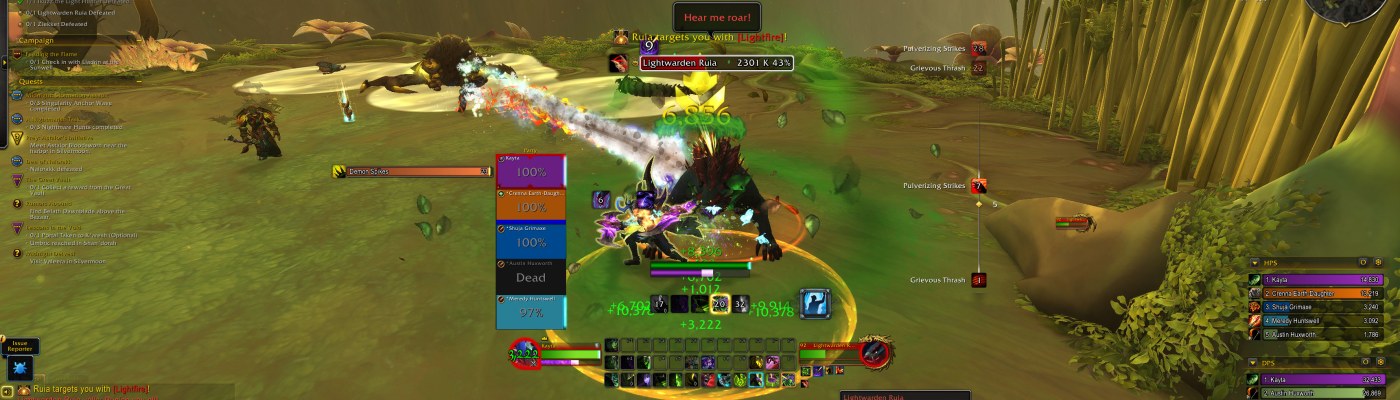
When I did my three-part breakdown of the dilemma posed by Blizzard’s annihilation of the combat-facing portions of their addon API in the upcoming World of Warcraft expansion Midnight, there was a missing piece of the puzzle that we discussed in brief, but could not fully quantify at the time – the encounter design paradigm in the coming content and how that might adjust around a future where combat addons cannot solve or even store data about mechanics.
Blizzard’s proposed multi-prong approach is a simple but potentially good one, in that while they’re removing things that addons have been able to do for two decades, they’ve also chosen to streamline combat design by simplifying class and spec design to reduce complexity in gameplay and tracking, improving the visual language and clarity of the game through better visuals, by including their own mutant offspring of popular fan-made addons like boss mods and damage meters, and simplifying encounter mechanics to make them more readily solvable in a world without addons to do the heavy lifting, either by smoothing out the amount of processing that needs to be done by a player at a given moment or by allowing enough time or flexibility to solve something that might take a moment of additional thought. Now that a first round of raid testing has happened on the beta realms and Mythic Plus has been tested in the retro-half of the Season 1 Midnight dungeon pool…we can come back to this point I had to leave unsatisfyingly vague in that original post series and I can add my own concerns and a dilemma I have been struggling with personally as a raid leader.
The Concept of Affordance and What Can Be Done Without Addons
Blizzard has a term they like to use to discuss how encounters give room to solve things called “affordance.” It’s very flowery and designerly language that translates simply to the wiggle room available to solve a mechanic. Something with high affordance means you have a reasonable amount of time to solve the mechanic, the mechanic doesn’t require a painfully precise solution, or some overlapping combination of these factors. Low affordance likewise translates to a mechanic that gives little reaction time, requires high precision on placement or behavior, or, again, a combination of the two. Difficulty in WoW is largely created in PvE through varying measures of affordance and recover-ability – a mechanic can be easy-ish to solve and thus very punishing for getting it wrong (Dark Matter on Dimensius Heroic and up comes to mind, because getting your puddle out safely and moving out of it quickly isn’t hard but if you fail at it you are punished with either a permanent area denial effect that makes the phase substantially harder or taking a lot of personal damage due to not moving well – maybe even both if you royally bungle it!), a mechanic can also be hard to solve and fairly non-threatening if failed (routing on Broodkeeper Diurna back in Dragonflight was a tough task but there were plenty of ways to recover and keep a pull viable even if you went completely off-road with your egg pops), or some moderate amount of both (Fractilus walls come to mind, as they aren’t hard to solve but require some teamwork and attention, they can be recovered but how much so depends on how badly your group has placed things to that point).
Right now, with the current addon API, there are some things that will just never be that challenging – operating under the assumption that players can and will use addons to solve the problem. If players get matching debuffs, an addon can tell them who they are matched to and even assign a stack marker for them to use, dispel mechanics for healers have to use kiss/curse effects so that healers don’t just blast a button in Decursive to immediately dispel, and these layering of effects creates a lot of the interesting challenge in modern WoW. While not every mechanic is a multi-layered clusterfuck of things to manage, most fights in modern WoW have at least one mechanic that has a branching path resolution based on available resources, encounter timing, and play skill of the group in question.
So what kind of stuff is Blizzard doing to create challenge in Midnight, at least so far?
Well…there’s some actual neat stuff here.
Chimaerus, the singular boss occupying the Dreamrift raid at launch, is a fight based on two major themes – area denial and split raid execution. A tankbuster causes a stack mechanic that half the raid at a time has to use to traverse to a shadow version of the fight, where adds spawn and you have a limited time to burn the shields on the adds to send them into the normal realm, where they fixate the boss and try to feed him for a small heal and damage burst. The upper group has to coordinate to pull the boss away from a designated add spot while the lower group has to burn the shields with coordinated AoE burst, sending the adds up and forcing the upper group to burst them down before they can reach the boss. Positioning matters heavily for this and also a pair of other mechanics for area denial – yellow gunk being placed at random player locations that can be removed with a debuff upon dispel, but because the platform is small, you’re forced to try and keep the raid as tight as possible to avoid gunk sprawl and make it so the debuff can remove all or nearly all of the goo, but then you also have this tug in the other direction because of the need to have the boss in one spot and the adds further away so they cannot immediately be consumed once they are brought up into the main encounter realm.
This isn’t exactly a crazy mechanic or anything super unique necessarily – WoW has had variants of mechanics like this for a while, but you can see the aim here in a general sense – there is a tighter focus on correctly executing a smaller, more easily understood set of mechanics, but the penalty for failure is relatively higher. In Soul Hunters in Manaforge Omega, there is a similar area denial mechanic with the opposite idea (dispelling removes the ability to absorb the AoE puddles!), but the cost for failure is relatively low – puddle soaking is rarely the singular make or break part of the fight but it carries a snowball effect that makes the other mechanics harder to execute, usually by requiring more movement to avoid damage. In Midnight, in this fight, the AoE puddles spread fast and can quickly make the fight untenable, but you have a relatively simple core concept to execute against to avoid that failure state happening, and a set of easy to implement strategies that can make managing the adds while also doing this straightforward.
It requires the whole raid executing correctly, which means if you have a ranged DPS player who cannot sit still, they will be a liability on this fight because they will cause the gunk to spread out crazy which means the dispel will be less effective which means you will, eventually, run out of space. The spirit of the idea is still quite similar to the modern game, but there’s less tracking you have to do – the gunk goes out as an instant so there is no good time to spread (just hold a position) and the dispel doesn’t require a stacking debuff or anything that needs to be carefully monitored – the player with the debuff goes into the goop and a healer targets them with a dispel, easy enough, but there is still an execution component that has to be met. The positioning requirement changes throughout the fight as there is also an intermission phase that has the boss swooping down from flight to leave a goo trail that is player-baited, so you likely want to have a fixed and tight raid stack and move as a group to place the goo together with existing puddles that might still be up and also out of the way like near edges so that the spread rate is slowed.
One more example from the finale fight of March on Quel’Danas (a fight I won’t spoil the actual boss of) – a memory game mechanic. The boss fires off a sequence of marker icons as a cast, then targets random players and gives each of them one of the markers in that sequence, and then casts and shoots a rotating laser beam. Your goal as a raid is to line up the marked players in sequence such that they match the original pattern the boss showed when activating the mechanic, or otherwise the raid takes a big AoE damage hit and DoT for each symbol hit out of sequence. You get a pretty reasonable amount of time in the initial warmup of the mechanic to set everything up (it’s north of 10 seconds) and then because the beam rotates, you have high affordance for movement and corrections to occur – the beam travel pattern is pretty quick, but by the time it starts hitting players you’ve had around 15 seconds to puzzle it out and align everyone well.
This isn’t a hard mechanic at all in most senses of the word, but it is something that could not happen at all under the current state of the game, because an addon would solve it and tell you where to go instantly. In the best possible design case in the modern game, it would use private auras to assign shapes to players without a visible debuff to anyone but that player and then a solver WeakAura could exist that would let you hit your symbol along with the other assigned players and have it tell you the ordering. In that case, would it be a fun mechanic or interesting to solve? Probably not. In the Midnight case, it carries some value – you have to recall the sequence from memory, but that memory is short-term and could be done by a raid lead quickly jotting notes or calling it out rapidly in voice comms. It pulls your attention in a different direction but in an orderly way that gives enough time to be doable without requiring instantaneous solving of the order or placement.
In that way, I like ideas like this a lot, because it makes for a fun twist to a fight that isn’t just about the normal combat interactions of the game and places some tension on movement and downtime to solve in a way that I enjoy in Final Fantasy XIV’s Savage raid encounters, where this style of mechanic is much more common. Something along those lines I’d be excited to see in WoW is memory mechanics for more normal combat stuff, like FFXIV has mechanics where a cast goes off earlier and is stored to inform how a major mechanic will work as much as a minute later into the fight, requiring you to observe and note the original cast based just on a casting bar or encounter prompt and then have the response planned ahead of time so that the group is properly positioned, mitigated, and able to execute when the mechanic finally arrives. Even with a small number of possible combos, stuff like that makes fights more interesting and creates wrinkles in execution that can be fun.
Blizzard’s Boss Mods, Encounter Visuals, and Overall Clarity
Now that we’ve been able to see them, it should be said that Blizzard’s boss mods are…fine. They are about what I expected when they announced they’d be doing their own, which is that you get a basic timeline that tells you by the fancy flavor name what is about to happen and it is your job to know what that means and respond accordingly. It is DBM or BigWigs minus the coordination parts – no telling you what marker to go to, no action guidance at all short of just the mechanic name, which means you need to know what that name means and how you should be responding to it. In a sense, this is genuinely fine – Blizzard clearly wants players doing more thinking themselves and are lowering the amount of total cognitive load by shifting a smidge more towards players in a logical way while removing a lot of what would have been solved by addons before, as we discussed above.
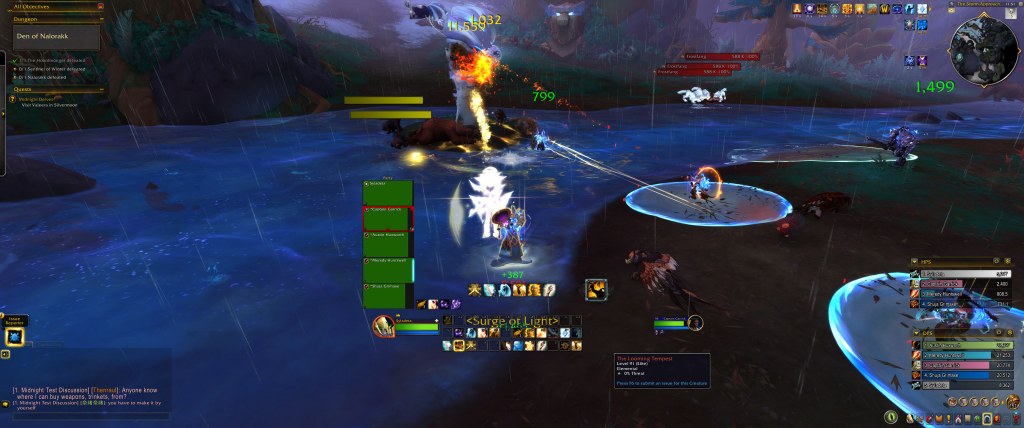
However, this is also obviously not a real replacement for existing boss mods as much as it is the shadow of them at best. And, here’s the rub – in a way, that is actually a good thing, because Blizzard’s grand design ideal here is that the fights should be overall easier in a way that you have the time and mental capacity to puzzle through what Alndust Upheaval means, so when their boss “mods” yell about it at you, you have a moment to think, consider, and respond. In the current state of the game, these would be piss-poor replacements at best, but in the new state of affairs, it’s actually not bad in general. Some players will absolutely struggle (I will be talking about that through my experiences personally in a moment!) but it should be generally good enough.
Where I have some fear is in Mythic Plus, where these issues are kind of more problematic. Without dungeon WeakAura packs, there is missing trash information that isn’t included in Blizzard’s boss alerts, and while the retro-half of the pool has been redesigned consistently to avoid some issues (even Algeth’ar Academy as the newest “retro” dungeon has seen reductions in caster mobs and overall threat from things like multi-bolts), there’s still plenty of places in dungeon gameplay where the speed of things is pretty fast. And, to be honest, I like the idea of a gameplay division in that way, with raids becoming more methodical and carefully planned endurance checks while dungeons can lean more into being speedy runs through a series of mechanics – but without any support from the community, Blizzard must meet the challenge they have self-imposed to make dungeons learnable and doable for the average player in a way that also scales well into high keys and harder challenges. So far, they’re actually kind of there – and that’s reassuring in a way!
One of the major things that Blizzard did all the way back in 11.1 was the revamp of encounter visuals, with new AoE graphics with harder edges, consistent visual language for soaks, stacks, and spreads, and better contrast through simpler visuals that stand out more – but some of the dungeons on Beta fail here, like on the first boss of Skyreach, whose chakrams use the new visuals…but the effect radius is larger than the visual, so that is a tad problematic! These changes applied to the retro dungeons returning is nice – it’s at least clear that Blizzard isn’t giving up on the idea – but there needs to be better quality control and some refinements to color and contrast for these to work without as many addon-provided warnings in the game.
So overall, is the clarity of encounter mechanics doing well so far on the Midnight beta? Yes, mostly. There are certainly some refinements to be had and some errors to be fixed, but the visual design, boss callouts, and reductions in layered complexity lends well to a new style of WoW gameplay that doesn’t feel foreign to the game but is a little lighter on computational complexity in favor of simpler styles of mechanics that still tease out some brainpower without being too simple or burdensome. A lot of what we can see so far on Beta feels weak in one major way – tuning, but that is an easy-enough lever to correct so hey.
Getting a Bit Personal – My Perspective as a Raid Leader Going Into Midnight
Alright, so I did a lot of preamble here to get to something that has been gnawing at me a lot and that involves my perspective on Heroic raiding, who can do it, and how I handle raid leading it and making decisions about how to stock the roster and ensure a good experience for everyone but also for myself.
Three years ago I started my current guild and took a team of raiders that I knew with me to establish a new roster. My grand hypothesis at the time was that they were underserved in an environment with a lot of above-average players who weren’t always patient or kind in giving them the space they needed to learn and grow as players, so if they could be put into a team where they would have the space and grace to learn in a more relaxed manner, they would skill-up and the average distribution of skill would tighten over time. My goal as raid leader and the role I saw myself playing was to help guide that process – to provide the room to learn, the resources to help build skills like guide references, peers who could help coach, and an in-raid environment that was socially-focused with brief but pointed raid calls and a structured plan for how we would tackle raid fights. The challenge I have had over time, however, is that I have to walk a fine line with being patient but also being willing to observe and act when improvement is not happening, whether to a sufficient pace or at all. I say that in good faith too – I believe that when I’ve had to be a bit tougher as a raid leader and demand improvement, people are trying to improve, but for various reasons it just isn’t quite happening all the time as I hoped and expected it would, and it creates a tug-of-war of tension on me – do I hurt a couple of people by needing to sit them or asking for more improvement as a conditional to continue raiding, or do I let them continue to chug along and bother the players who are executing well who then feel less motivated, less excited, and less social as a result? It is a tough call, and to be fair, one I expected I would have to handle every now and then, but I have, admittedly, not always been as sharp here as I would like, and I’ve often been overly patient with struggling raiders at a cost to the social environment and gameplay quality.
I’m proud of a lot of the things we’ve done as a group since the beginning – we’ve consistently reached Ahead of the Curve and Glory meta achievements each tier since forming, we’ve remained a top 60 guild on our server cluster, our time from tier start to AotC has gotten shorter each time (in The War Within, we went from 18 weeks to 14 to 12 across the three raid tiers on offer), and we’ve had a growing number of Keystone Masters and Heroes as well as a couple of Legends since that became available (not just me!). However, I know that there is a degree of frustration with consistent mistakes from a handful of players, and it is very understandable because I’ve felt it too – when 3-5 players can each make a small mistake and that leads to a wipe, it is irritating enough, but when it happens on a more regular basis and often from the same players, it gets a lot harder to manage. Fractilus this tier was, for me, a breaking point – it is a simple fight with high affordance, but I had a handful of players who I could not get to position correctly to save their lives – literally – and it became illustrative of how the addon issue is going to rear its head in Midnight for me.
I try normally (and often excruciatingly so) to buffer discussion of difficulty – that what I think is easy may not be easy to everyone and that some grace is required when trying to skill-up a player on a mechanic, but I think in the case of Fractilus, it is genuinely an easy fight. As long as people look to see how the columns are stacked and ensure a spread of arrows for their wall lanes, there’s just no bite to the fight – it can be done simply without WeakAuras or even boss mods with only a modicum of attention being paid. Failing at Fractilus is annoying and disappointing because it means a ton of things need to go very wrong over a prolonged period of time – it is rarely a single mistake or even a handful of them but a literal pile of simple misplays on a fight that gives you so much time to respond to everything and pretty clear visual indicators for every single mechanic. Genuinely, there was a point where I almost logged out on a Fractilus night because I was so beyond annoyed with the lack of rigor in play and it wasn’t easy to correct as a raid leader – you get a generous timer for walls but not so much that a raid leader could call out every assigned player or assign manually, and while a WeakAura can force the assignments, it has always been a goal of mine to avoid requiring WAs for raiders at all because I don’t want to do the version update shuffle instead of pulling and playing.
It showed me a side of the addon change that I am still, even as positive as I was up-top, not fond of. In today’s world, especially the last two tiers, with modern AoE graphics and a full slate of boss mods, WeakAuras, and timers, players can still poorly execute and fail at basic things. New AoE graphics are great, but some players never watch their feet and then get wombo-comboed by being in 3 circles on a fight like Loomithar where the contrast is actually great, bright pink circles against a green floor. And, to be fair, for me as raid leader, I am apprehensive about what it means that all my extra tools are being taken away – no WeakAuras at all for notes in-game based on encounter, no dungeon callouts on trash, no timelines and tells about who has what to use to count down and pre-call mechanics – a lot of these are things I rely upon to make my life easier and to be able to handhold a bit more (more than I would like to have to, admittedly, but it helps all the same). The thought that is looming in my head as I start to prepare for expansion release in March is this – if I am frustrated now in a world where every single mechanic can be spoon-fed to a player through boss mods, WeakAuras, raid callouts, AND clear visual language and still see a large number of mistakes and misplays in that environment, what can I expect to feel in the new world (of Warcraft) when a majority of those things are taken away or reduced due to new design philosophy?
That is the thing I think a lot of people miss with this issue. Sure, in theory, you think the high-end guilds need these tools a lot more, and in some ways that has been true, but WeakAuras and boss mod addons have been the connective tissue for every casual raid I have ever run in, far more than even the Mythic raid bosses I tackled this expansion. While everyone wants to clown on the race to world first guilds for their suites of addons, the actual truth is that far more modest raids are held together and able to execute because of action-focused rapid callouts from boss mods and utilities with them that allow a savvy raid lead to make early calls to pre-position, and their absence is likely going to cause some teething pains for groups who have needed that level of help to this point. Even in a world with simpler mechanics and less class and spec stuff to track to play well, there is a very real and substantial fear of how these addon changes are going to make things more challenging for these types of groups – and my own is certainly in that bracket.
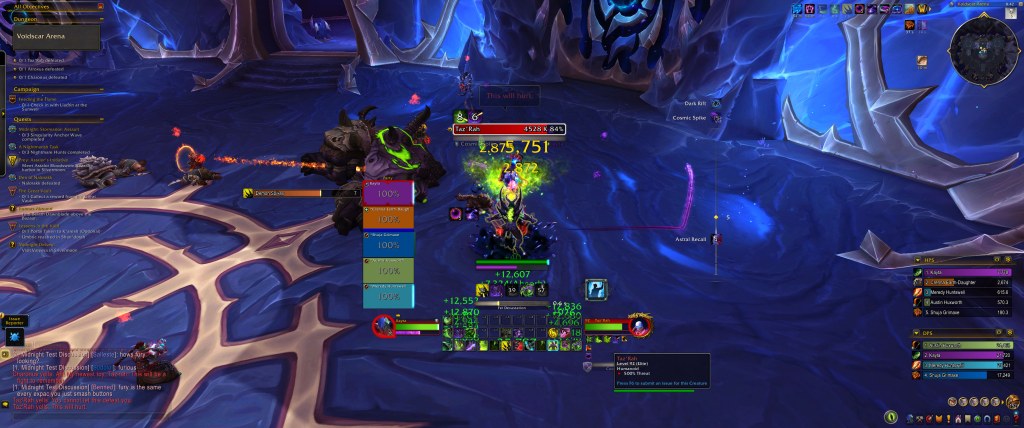
A fear I have personally is this – that if I already feel a degree of burnout in the current state of things with all of these tools available, how will I feel if I continue on as-is and what are the options to try and maintain a group when that degree of assistance fades away? The obvious part of the answer for me personally is that it cannot continue on in the same form as today, because that is already a state that I feel highly burned-out on and so trying to do that is going to lead to a worse outcome for everyone. In that way, the addon changes being made by Blizzard are actively kind of stressful to me, because as a player myself, I have confidence I can build my Blizzard-brand UI in a way that works for me and allows me to maintain my play at the level I am currently at or thereabouts, especially after seeing some of the tweaks on Beta to specs I would likely main in Midnight, but I don’t have that same level of confidence at a group level and when we already encounter issues with slower-than-expected improvement, well, that’s not a good recipe for an enjoyable raid scenario. In that regard, I imagine I am far from alone or unique in terms of raid leaders reassessing team compositions and expectations for progress moving forward.
I think this is the thing at the core of the addon changes that is harder to observe individually and one I think Blizzard underestimates. Individual players all have their own takes on how the changes are going to work and feel for them personally, and those are all valid and worthwhile takes to evaluate when making this change, but I think the social fabric of the game will change a lot for this as well – and not always in a good way. There’s been a non-zero amount of thought in my head that maybe raid leading isn’t going to be worth it in the new state of things, that maybe I’m not in a space where I want to do that when players have less information personally available and already struggle even with that information available. I think the players that form the backbone of a lot of groups in all types of play are going to have some challenging scenarios like my own ahead of them, and the answer isn’t always going to be to continue on or do so with minor changes, but may involve stepping back or stepping away and that’s not an ideal scenario for Blizzard or those player groups. A lot of this, of course, depends on encounter design and the overall content structure that matches with the class and spec changes we’ve already seen, and so far on beta, Blizzard isn’t in a bad spot there, but each group has its own challenges and the calculus will align a bit differently based on those group structures and unique challenges.
Wrapping Up
In many ways, I continue to find Blizzard’s approach to addons in Midnight baffling, to say the least. The approach seems to be haphazard, poorly communicated, and poorly implemented, and Blizzard has already had to have multiple interviews and comprehensive blog posts trying to outline goals and ideas after they’ve botched the initial implementation of just about every one of their replacements in Midnight. Some of the tools have gotten better over time which is great, and obviously I don’t expect some of the tools to ever be as good as the addons they replace since that is the point of Blizzard tightening the restrictions – but even within stated goals, there is a long way to go for these replacements to feel at least okay and Blizzard has been struggling to meet the moment.
At the same time, however, the current state on beta isn’t actually that bad, and while it feels different in some good and some less-good ways, the most WoW I have played in the last couple of weeks has been some grind sessions on Midnight beta just seeing new dungeons and delves (yeah I did one to see how the boss mods worked there and they don’t!), and not just for the novelty of it – it is a reasonably good play experience. I even did some tank stress tests solo pulling the lasher clusterfuck in Algeth’ar Academy on a +12 to see how it felt and that was actually fun!
Even though I think Blizzard’s goals with this move are reasonable and even potentially worthwhile, I do think that there remains a high risk of damage, both direct damage for players who need their addons to play in a way that they find satisfying (which yeah, sure, maybe a skill issue, but from the business POV still sucks) and splash damage to groups who might encounter issues that addons and tools were previously masking effectively enough. As it has been from the beginning, Blizzard’s desire to quickly shift the combat addons out of the game remains a gamble with the full result yet to be seen.
 Kaylriene
As someone who has noticed his own reaction times start to get worse do to age, it isn’t fun to realize that you’re sometimes dragging the group down. I’ve switched roles from tanking to healing to compensate for that, plus I’ve let my raid leader know I don’t have any problem sitting on the bench if it helps the group progress. I know they’ll pick me back up later when the group, as a whole, is better at a boss fight.
I think that’s part of what we’re going to be seeing rippling through the community. While the devs are trying to make things more approachable, the community itself is going to have to step up and have more personal responsibility to execute the fights, to actually play the game and not just do what an addon tells them to do. Raid groups that try to include ‘two left feet’ raiders are going to find that they may need to just take one person at a time for various achievements/rewards.
My raid group has tried in the past to help folks learn fights well enough that we could include them. It’s painful, even when the person is trying, is working on their skills, but still just quite can’t make it. At some point people (and us!) need to realize that skill caps do exist and you can only get so far. You could train all your life as a runner and still never run a sub four-minute mile. Cue the unpleasant side of leadership of telling someone the brass ring they want will be forever out of their grasp.
I am onboard with Blizzard’s changes. I think addon apocalypse is for the best, but I am accepting that these changes will take time to mature. I expect the first raid tier or two of Midnight will be fairly rough as Blizzard and the community work out where all the pain points are. I am hoping when The Final Titan releases we’ll be in a good place where most of the pain is forgotten behind us.
LikeLike