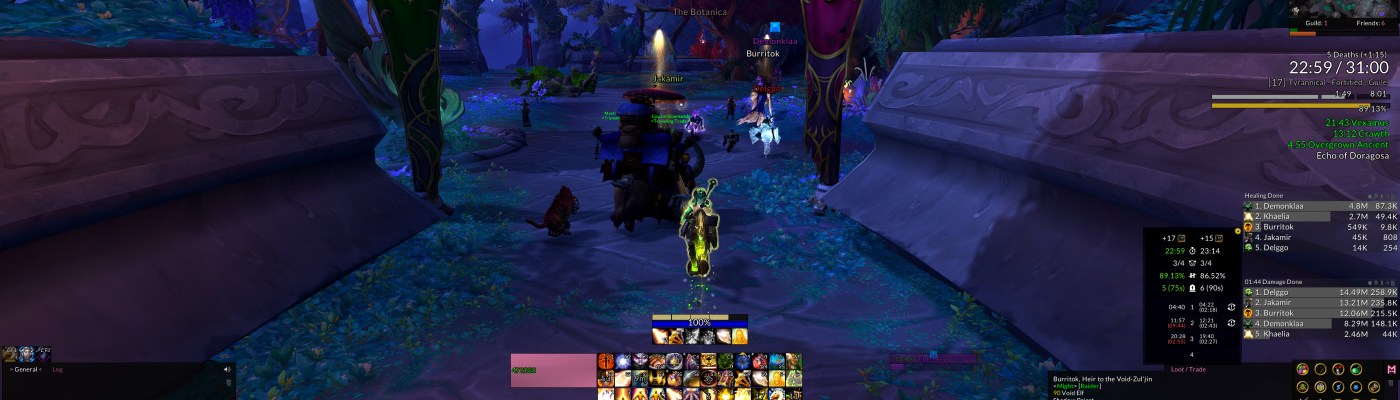
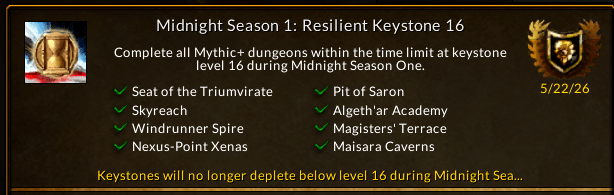
In the wee hours of the early day on Friday, May 16th 2026, I reached a new record Mythic Plus rating at 3,410 and obtained the Keystone Myth achievement that was recently added to WoW in the 12.0.5 patch on my current Holy Paladin main. With one timed +17, 5 timed +16s, and two +15s, I had done it – reached a new level of achievement, put myself into around the top 5% of players globally, and secured a mount token, which I used to buy the new recolored Cerulean Deathwalker, a brighter blue take on the Shadowlands KSM mount.
As I like to do with these milestones, I wanted to take a moment to collect my thoughts on the process, reflect on the pursuit of this new goal, and then to look forward, given that reaching this achievement places me pretty close to being able to chase the 1% mount that was also added and maybe, potentially, to attempt a 0.1% title push.
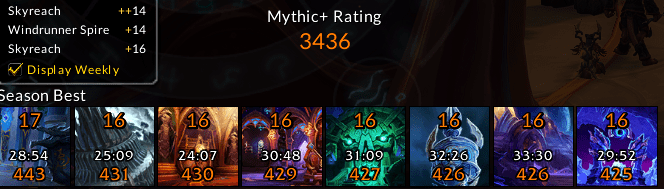
First, my current progression (as of this writing on 5/23/2026)!
Upgrading Difficulty
One thing I was not exactly prepared for is the escalation in difficulty as you climb key ranks.
Sure, on paper, I get it – 10% per key level of extra mob health and damage is a lot, especially given the multiple scaling mechanisms between Fortified, Tyrannical, and Xal’atath’s Guile on top of key level scaling, but at the same time, the push beyond Keystone Legend has no new affixes or differing mechanics to learn – everything just gets more punishing as it is. It is this wrinkle, however, that adds up to the most – because while yes, nothing fundamentally changes about how mechanics work, the punishment for failure is substantially higher. Up to even +14s and some +15s, a DPS not hitting a defensive on certain partywide damage events is survivable and recoverable, and yet on some 15s and beyond, those same mechanics become one-shots. Not unfairly, as you typically get a lot of warning and prep time this season to hit a defensive and prepare, but the one-shot will happen without that layer of preparation. As a healer main this season, I’ve had to learn and understand when the party needs to be topped-off and ready for such events, but I’ve also had to learn what I cannot fix myself and to be ready to handle when the DPS just die to their own negligence or lack of knowledge. The same applies to interrupts – I’ve had keys fall apart because one missed interrupt simply kills a tank or other target and then everything goes belly-up from there. Learning to analyze and unpack these problems and to learn where I could have helped has been instrumental in my self-improvement – but also helpful in understanding where I couldn’t have done anything and to not be hard on myself or accept critique from bad DPS players who could have saved themselves by hitting a defensive before they took the damage or by interrupting the one cast that led to tank death.
In particular, I also have generally observed that climbing from +15s to +16s feels the most steep, as that jump is the point at which a lot of failed mechanics turn from barely survivable in good gear to straight death. It’s also the point at which groups begin to get far more selective about invites….
Playing Queue Simulator 2k26
As you climb the ladder on keys, an interesting inversion begins to happen.
In the lower levels, there is an abundance of keys and a lack of players in certain roles like tanks or healers, which leads to plenty of groups a healer can sign up for, get quickly accepted, and get something done. The higher you climb, the more likely you are to begin encountering a key shortage, where there are plenty of players wanting to put up some IO but a smaller pool of available keys in the community. At that point, while established role shortages remain in place (tanks and healers are still in shorter supply), they can feel less pressing given that you might only have 5-10 active keys in your search at a given time, so the bottleneck moves to finding a key worth IO that doesn’t already have your role filled – and while that’s still harder for DPS players, certainly, it becomes a challenge for tanks or healers in a way that it really isn’t at lower key levels. Trying to even just get my first +16 on the board required almost more waiting and applying to groups for one run than I spent on queuing up every +15 I ran combined.
You also spend more time in queues due to another factor, however!
The Price of Failure
In higher keys, you start to see a lot more votes to abandon. Because not timing a key means 0 rating at +12 and up and the gear and crests are a minor reward at best (and gear is even pushing it since 266 gear is utterly uninteresting at the point you’re pushing those higher keys), a failed mega-pull or excessive number of deaths means that the group typically just calls it and goes their separate ways. And while this can feel bad at first, it makes sense – if the key holds no value to the group, then it makes logical sense to disband and stop running. It’s something I understood from pushing into Legend range, but for Myth and beyond it becomes especially crucial to protect your time investment, so the number of times I’ve had it happen has increased as I push higher.
To be fair, it is also common for groups to throw up the white flag on perfectly time-able keys, which is less cool, and it’s possible you get held hostage by a premade stack if you’re not feeling it (even in my Legend push Algeth’ar Academy took a few runs where the premades didn’t know what was happening and wouldn’t abandon even when it was painfully obvious we were not gonna be close to the timer), which is not a desirable outcome by any means, but I do think that the vote to abandon works largely as intended in higher keys and doesn’t feel too bad (once you get past the initial pain of seeing it happen more often, lol).
Healing Off the Metagame
By picking Holy Paladin, I resigned myself to being an off-meta healer and knowing it would carry some challenges. And it does!
I think at the levels most people play at, the metagame is a nuisance that less-informed players use as a filter at key levels where it quite literally does not matter. Any player of any spec can do your weekly +10 keys and can make the push all the way to the Myth rating achievement and even 1%, provided they play well and know what they’re doing in the dungeon. In high keys, it becomes far more noticeable the reasons why the meta forms the way it does.
For me as a Holy Paladin, the primary challenge is in healing throughput and timing. Because your biggest heals are either mana-inefficient (Holy Light) or Holy Power spenders that require building the power to use them (Word of Glory, Light of Dawn), you spend a lot of time trying to push health bars up with efficient but low-throughput heals like Flash of Light or Holy Shock, using talent buffs to help make them hit harder while you also hope for Infusion of Light procs to use on Flash of Lights and eagerly cycle your Lightsmith armaments (or wait to use Divine Toll as Herald of the Sun). Because there’s a lack of on-demand AoE healing and good AoE healing requires building your talents around it, Holy Paladin can struggle to answer the constant rot damage and quick spikes of targeted damage this season. It’s possible to build around that by taking Light of Dawn talents and focusing your efforts there, but it is harder than other specs. Notably, I took a fresh level 90 Restoration Shaman through to Keystone Hero in 8 total dungeon runs (one +10 of each) because the spec was so easy to play and had such good answers for the damage profiles this season that I didn’t even really need to fully understand the spell interactions – I could just drop totems and hit a Chain Heal when things got spicy and health bars would be pretty stable.
What also makes Holy Paladin tricky is that your Holy Power generation is tied to your global cooldowns, which means that if you are unprepared with Holy Power in the bank for major mechanics, you are scrambling and often in a position where every global matters A TON. Dungeon awareness and damage intake profile knowledge becomes mandatory as you push higher, because not knowing means you are always on the backfoot struggling. Which is an interesting position for healer balance in WoW, so let’s talk about that!
At High Enough Keys, Every Healer Has to Ramp
World of Warcraft’s modern healing paradigm splits two ways – between reactive healers, like Holy Priest, Holy Paladin, and Restoration Shaman, and proactive or “ramp” healers like Restoration Druid, Preservation Evoker, and Discipline Priest. All healers have some elements of both styles (Resto Shaman can prep Riptides onto multiple players and Healing Stream Totem to buffer incoming damage, Mistweaver Monk generally needs Renewing Mists out to help land their damage-conversion healing, both Holy specs have options with either HoT elements or damage-taken triggers that can be used to prepare for incoming damage, while Resto Druids have Swiftmend as a spot-heal, Disc Priests can use defensive Penance to spot heal, and Preservation Evokers can use spells like Verdant Embrace or even Living Flame to do the same), but generally there are two camps and two styles.
In low keys, it kinda doesn’t matter much, because both types of healer have pretty good answers for most damage profiles. Ramp healers can struggle with failure damage (anyone taking unplanned or avoidable damage becomes a nuisance when you have a specific plan of prep for a damage event in 5 seconds) while reactive healers can cover failure damage generally well but have to work hard when planned damage events happen. However, as key level climbs, everyone functionally has to learn how to ramp, because for the reactive healer types, you can’t just YOLO blast the health bars – you need to have resources planned ahead, a structured way to handle each GCD as you dig out of the hole, and generally need to stick to that plan while also making tiny modifications based on externalities (visible defensive usage on other players, the next major damage event, failure damage, etc). The good news is that once you start really pushing, failure damage is less of a thing because it just becomes failure deaths, but the bad news is that not learning to plan before you arrive at that level means that keys feel way more hectic and scrambly than they did before.
My experience on Holy Paladin has been that learning what trash mobs have brutal AoEs and then ensuring I sit on Holy Power a few seconds ahead of the mechanic so that I can blast out healing immediately is vital. I’ve also had to adjust my UI back to the default Blizzard frames so I could have an easy way to see defensive usage happening and plan around that, and I’ve also had to learn to pool other non-Holy Power resources in a way that allows me to quickly pop off with fewer globals needed for major healing, like keeping Holy Armaments available so I can get quick 3 Holy Power boosts, holding Holy Bulwark for major damage events instead of forcefully cycling Holy Armaments on cooldown, holding Aura Mastery for planned damage, using my own defensives more vigorously for major unavoidable damage and prepopping to buffer better, and even placing Beacon and moving it around to shift healing as needed. Because of the nature of Holy Paladin, I don’t have a lot of ramp tools, so the ones I do have I must use intelligently and aggressively as key level climbs so that I’m not playing catchup, because around +16s, catching up basically ensures someone will die, even with smart defensive usage on their part.
Holy Paladin started the season with the recommended M+ build using mostly Word of Glory on players and doing almost entirely single-target healing, but as the season has progressed, Light of Dawn builds for M+ have taken off, in large part because they give a potent buffer when everyone is taking a lot of damage all at once. If I enter a mechanic like the Dreadbellow on Nysarra trash in Nexus Point Xenas, a Light of Dawn on the first major damage spike to the party means there is stability to then use single-target healing on players without defensives or players who were lower to begin with – and that kind of logic applies all over the season. The major healer mechanic in this season’s dungeon pool is rot damage, where everyone is taking relatively small but constant and unavoidable ticks of damage, and a Light of Dawn build answers that really strongly and allows me to apply some ramping logic – if I know the damage event is about to happen, I can hold Holy Power to send on Light of Dawn immediately after the spike, and if I have that plus pooled Holy Power generators like Holy Armaments, then I can quickly get another 3 Holy Power and use it again.
This need to ramp into damage events is also a huge part of why Herald of the Sun is popular for high keys, because it both has direct Light of Dawn buffs but also has core features in the Hero talent tree that emphasize HoT healing, like Dawnlights and Eternal Flame, which both allow you to purposefully pre-HoT someone for a decent amount going into a major damage event. However, a part of my push towards Resilient +16s was spent on trying the switch, and I found that my familiarity with Lightsmith meant that playing Herald wasn’t working. Plus, Lightsmith has a powerful ramping tool in Holy Bulwark, and as I have been learning to hold it for damage events and use it more intelligently, my dungeon performance has improved a lot while still keeping with the same build and ideas I’ve been learning over the last few weeks.
This process of learning and adjusting based on dungeon knowledge has been fun, because arguably, I’ve never played at a level where I’ve needed to both have this much dungeon knowledge and actually needed to use it fully to time a key. Sure, on lower keys, having the dungeon knowledge means you can breeze through the content and that’s cool, but there’s rarely a moment where high defensive utilization becomes truly mandatory until things are one-shots, where you need to anticipate the damage event multiple globals ahead of time and prepare, or where I really needed to know what players had defensives rolling at any given point in time. Testing all of these skills and really pushing into them has been a fun process.
Will I Push The 1% Mount Achievement?
So, as of this writing, I am sitting at 3,436 Mythic rating, which places me pretty firmly into the top 10% of players and just 250ish rating shy of the 1% threshold as of 5/23/2026 in the NA region. In fact, as of this writing, having done Keystone Myth at all puts me in the top 6% of players of both factions and the top 7.2% of Alliance players, and that is a good feeling to have achieved. Generally, with the missing rating I am sitting at, if I push my current key levels up by 3 across the board, I would be at the current threshold, which is likely, based on both the current season and prior season rating curves I researched when these achievements launched, to remain relatively close to the actual level needed. So for me, that would result in doing every key on a +19 and Algeth’ar Academy (or any key, doesn’t really matter at that point) to a +20. That would have sounded absurd a few short weeks ago, but since I started pushing towards this level of play with the 12.0.5 patch, I’ve climbed over 400 points of rating and pushed 4 new Resilient key achievements I never once did before, even as I was pushing like a maniac in The War Within. Climbing another 300 or 400 points would be crazier still, but it also feels quite doable. The season still has two new mechanisms coming in patch 12.0.7 that will further push player power – the 298 gear from Mythic Flex raiding the new Sporefall single-boss raid and the Omnium Folio, a borrowed-power catchup mechanic that functions like a talent tree with throughput and defensive-oriented nodes that will push power ever higher.
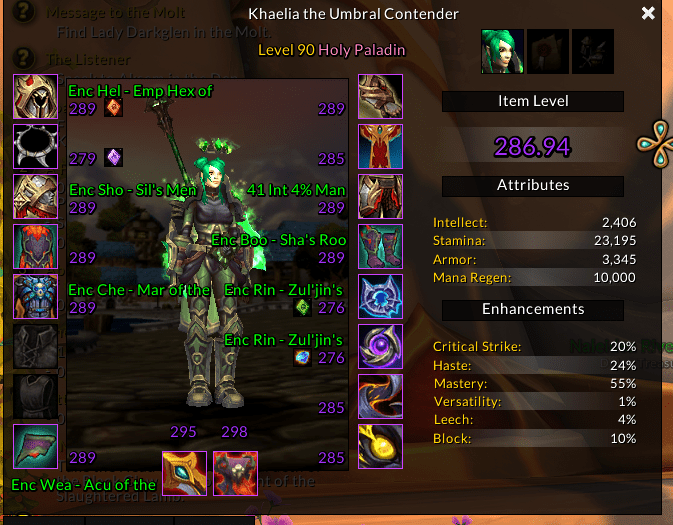
In terms of current gear progression, my Paladin is nearly maxed out as far as I can take her without compromise choices or Mythic raiding. I have Myth gear in every slot except both trinkets, which are Hero-track raid trinkets with high power levels, one of which I could potentially get on Myth track if I tried (Chimaerus is very easy to run on Mythic in a PUG as a single-boss raid that isn’t much harder than the Heroic variant) and one of which I absolutely would not get on Mythic at this point (I currently have a maxed Locus-Walker’s Ribbon from Crown of the Cosmos, and doing that on Mythic is…not gonna happen, lol) so if I wanted higher raw item level, I would need to give in and accept a Myth trinket from Mythic Plus, which is not exactly the best option (there are some decent ones like Heart of Wind or Emerald Coach’s Whistle, but both are underpowered relative to the raid trinket options I have even though they are Hero track), so as of this writing I have a cool 220 Myth Dawncrests separating me from my maximum current gear potential.
What all of this means is that if I choose to push for 1%, I have two legs to the journey before me – the weeks prior to patch 12.0.7 (estimated for either mid or late June), where I can push those last Myth Dawncrests now that no cap exists and max out my gear while pushing harder keys, maybe take a Myth-track trinket journey into a PUG Mythic Chimaerus run or use Nebulous Voidcores to roll top-tier options from M+, and then decide to roll my progression forward as best as I can (currently +17s would be the next level, with maybe some flexes into +18s as I can manage), and then will come the weeks after the patch, where my goals would be to max out the Omnium Folio feature for more player power while also potentially joining some PUG flex Sporefall Mythic runs for a chance at 298 Myth gear in some choice slots – there is a plate chest with optimal Holy Paladin stats, a belt with eh stats (which would also replace an embellished slot for me so maybe not), but also a neck with a healing cantrip effect and a ring with optimal Holy Pally stats too. Theoretically, with these power boosts, the current estimates I have of where I would need to land are in reach, but at the same time, it will be interesting to see how the 1% develops over the end range of the season.
In the past, catch-up mechanics were pretty lousy for pushers, because at best the borrowed power item du jour would maybe be optimal (and usually Blizzard buffed it into being so) but there wasn’t a secondary mechanism like we’re seeing with Sporefall this time around. Even in Turbo-Boost seasons in TWW, there was less of an immediate spike or blip in the data and the rating curve stays pretty consistently low-elevation until around the last week of season when the 0.1% title pushers ramp up and do big final pushes to make their goals happen. There’s also still some unknowns around how gear might progress further in Season 1 of Midnight, because the current Ascendant Voidcore system already has an interesting tell – all max-upgraded gear lights up as eligible when you go to use one, even though they only currently work on weapons, off-hands/shields, and trinkets. It would be an easy engagement win for Blizzard to simply make the Ascendant Voidcores able to upgrade any Hero or Myth-track gear at maximum Crest upgrades and use that as the “new” method of Turbo-Boost, and that would also align to non-weapon and trinket gear in Sporefall being on the Voidcore upgrade item levels, so it seems to my eye to be somewhat likely to happen. That’s also assuming Blizzard doesn’t just simply roll out a normal-ish Turbo-Boost as they did the last two seasons, although there is a lack of evidence for this in the patch data, but that also may not mean much given that Blizzard has hidden a lot of key details of announced systems in Midnight (Ascendant Voidcores were a big question mark right up to launch day) so it is very possible that we simply don’t see any pre-announcement or datamined evidence of Turbo-Boost until Blizzard pops it in as a surprise.
On the desire front…I’m not sure how I feel about 1% just yet. Logically, I like pushing, I have been enjoying doing harder keys and feeling that mastery of a new class and spec grow, and the promise of a mount reward is very tempting. On the other hand, however, the mount is an unknown (Blizzard has shown no previews of the 1% mount and there’s every reason to believe it will just be a variant of the seasonal Carrion mount which might not be too exciting), 1% pushing involves a lot of effort and increased time just queuing and running fractional keys until you eventually succeed, and unlike all the other goal points I have gravitated towards hard in Mythic Plus, 1% is a floating target in a season that is and will still be introducing a lot of new variables that complicate the math and logic behind approaching it. There are reasonable assumptions to make which I have made when discussing it both here and in the past, but there is also a mental drain that can come from, for example, targeting doing all +19s with a +20 in the mix and then finding out that it will actually take all +20s or even a mix of +20s and +21s, not to mention that the traditional seasonal curve hits a huge spike in the last week so any prep I do up to that point is still going to result in me pushing very hard the last week with an uncertain outcome floating in the wind. There’s also the question of balance – I raid, I have an alt army I would like to raise (although I am just a Rogue away from having every class to 90 at least!), and I also am active in two different Final Fantasy XIV raid teams. I also have a lot of competing interests outside of gaming that need attention and so as the time demand scales upwards, my ability to meet it does not.
All of this is to say that I’m not sure how dedicated I am to pushing the 1% goal just yet. I will continue to grind, because I am having fun pushing my limits and growing as a player, and unlocking Resilient +16s this week was a huge step forward that I really enjoyed accomplishing, but I’m not trying to place the pressure on the long-term goal just yet. Right now, it is remaining fun to break it up into discrete smaller goals with shorter time horizons, like each Resilient key level, every 100 points of additional rating, every gear upgrade threshold, and every time I climb into a new ranking position (currently in the top 4,000 Holy Paladins in the world, top 750 in NA region, and 5th best on my server cluster!). It’s fun for the sake of it and not necessarily the reward, and as long as I retain that outlook on it, I think I can do the push in earnest while keeping it fun and healthy for me.

